
Why Montenegro Now?
Key Takeaways
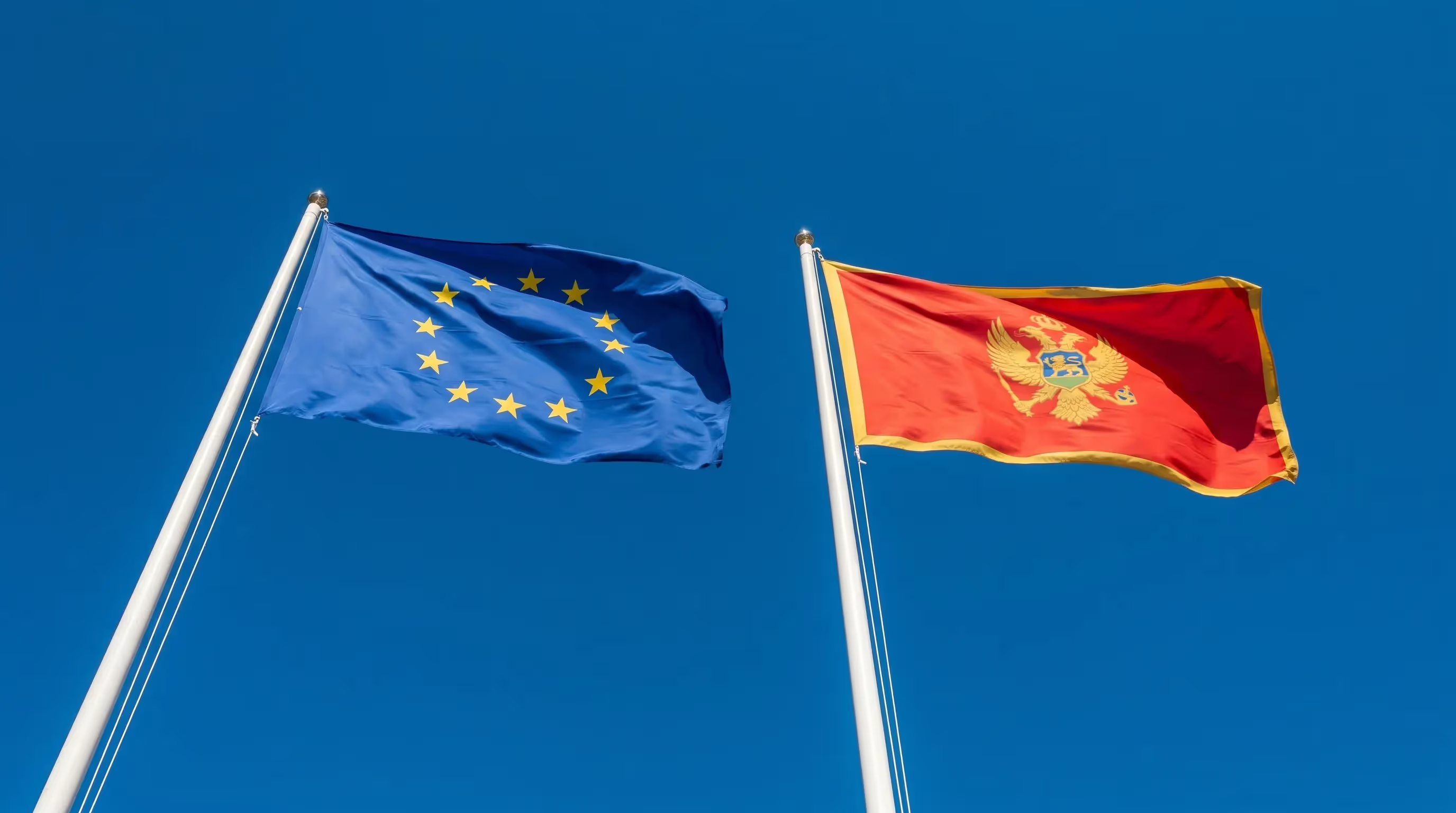
- On May 13, 2026, formal preparatory work began on Montenegro's EU accession treaty — the first such process initiated for any candidate country since Croatia. All 27 EU member states agreed unanimously.
- The EU has released over €62 million to Montenegro under its Reform and Growth Facility since 2024, tied to verified reform delivery — not symbolic funding but strategic investment with measurable conditions.
- British Airways launched the first direct Heathrow–Tivat service in May 2026; Wizz Air opened a permanent Podgorica base with 23 routes; Flydubai opened a daily Gulf corridor. Starlink is confirmed to launch in Montenegro by end of Q2 2026.
- Montenegro is not a frictionless market — bureaucracy, banking complexity and planning inconsistency remain real. The relevant question is not whether problems exist, but whether the trajectory is improving. At present there is a credible case that it is.
On May 13, 2026, formal preparatory work began on Montenegro's EU accession treaty. The decision to establish the working group had been taken unanimously — all 27 EU member states — on April 22. EU Enlargement Commissioner Marta Kos marked the moment simply: "Montenegro's place inside the EU is now taking shape."
That is not diplomatic boilerplate. Formal accession treaty drafting has not begun for any candidate country since Croatia. That it is now underway for Montenegro is a concrete legal step, not a ceremonial one.
This momentum did not emerge overnight. In October 2025, Commission President Ursula von der Leyen visited Tivat personally — not Podgorica, Tivat — as part of the EU's Western Balkans tour. She named Montenegro the frontrunner among the six accession candidates and signalled that five more negotiating chapters could close by year end. For a town of 14,000 people on the Adriatic coast to host the European Commission President for a working session on EU enlargement is not routine. It reflects where Brussels' attention has been directed.
For many international buyers, Montenegro remains better known by association than by familiarity — often discovered via Croatia, Dubrovnik, or a passing awareness of the Bay of Kotor. That relative obscurity has long been part of the story.
So too has a certain scepticism. Can ownership be straightforward? Is the banking system easy to navigate? What does long-term stability look like? Is this a serious market, or simply a beautiful place with occasional speculative enthusiasm attached to it?
These are reasonable questions. And yet something has been changing — not overnight, not dramatically, but steadily enough that it deserves attention.
The European Union is committing political attention, institutional effort and tangible capital to Montenegro in a way that is becoming increasingly difficult to dismiss as symbolic. For international buyers, investors and globally mobile professionals, that matters.
Not because property prices automatically rise whenever diplomats make encouraging remarks. But because the broader environment in which people make long-term decisions — whether about second homes, relocation, investment or business presence — is shaped by direction of travel. And Montenegro's direction, at least for now, appears clearer than it has in years.
Why Montenegro?
The European Union has no shortage of competing priorities. War in Ukraine. Migration pressures. Energy security. Economic competitiveness. Relations with Washington and Beijing. The constant balancing act of governing a bloc of 450 million people.
Against that backdrop, why devote political capital to a country of 620,000 on the Adriatic?
Part of the answer is geographic. Montenegro sits in a strategically important corner of the Western Balkans, a region where long-term stability has been a consistent European objective. The EU's interest in anchoring the region within its institutional orbit is neither new nor surprising.
But geography alone is not enough. More specifically, Montenegro has positioned itself as the accession candidate most plausibly capable of progress. It joined NATO in 2017. It already uses the euro. It has been a SEPA member since October 2025. Public support for EU membership runs at around 80 percent, with no significant Eurosceptic political force. Compared with neighbours facing more acute political complexity, institutional deadlock or slower reform momentum, Montenegro offers something Brussels values: movement.
Brussels also needs a credible enlargement story. If the EU wishes to demonstrate that accession remains a real pathway rather than permanent diplomatic theatre, it helps to have a candidate capable of measurable progress. Montenegro increasingly fits that role.
That does not make success inevitable. But it explains why this country matters more than its size might suggest.
Political Attention Is One Thing. Money Is Another.
Diplomatic statements are easy. Funding is harder.
Recent EU disbursements under the Reform and Growth Facility for the Western Balkans are worth noting not because they transform Montenegro overnight, but because they represent something more concrete than rhetoric. Reform funding comes with expectations: administrative modernisation, institutional alignment, governance improvement, practical delivery. This is not philanthropy. It is strategic investment tied to verified reform delivery, assessed twice yearly by Commission officials.
The EU launched a €6 billion Reform and Growth Facility for the Western Balkans covering 2024 to 2027. Montenegro has been a consistent recipient. A first tranche was released in July 2025. A second followed in October. On May 21, 2026 — this week — the Commission released a third payment of €44.2 million specifically to Montenegro, following a positive assessment of reforms in business competitiveness and innovation. Total disbursements to Montenegro since the programme began now exceed €62 million.
Serious systems reveal priorities through budgets, not speeches. And while reform funding may sound abstract, its practical implications are not. International buyers care about whether money can move predictably, whether contracts can be enforced, whether administrative processes improve over time, whether infrastructure becomes more reliable, and whether there is increasing alignment with familiar European regulatory norms. Few buyers would describe it in those terms, but that is often what they are really assessing.
Infrastructure Tells Its Own Story
If political speeches are the theatre of integration, infrastructure is the plumbing. And plumbing matters.
Montenegro remains a developing infrastructure story — no serious observer would claim otherwise. The country's mountainous geography makes major transport upgrades expensive and complex. Administrative execution can be uneven. Long-term ambitions do not always move at investor-friendly speed.
Yet the direction is notable. Rail modernisation — including ongoing work on the Bar–Podgorica corridor — forms part of a broader effort to strengthen internal and regional connectivity. The Port of Bar remains strategically relevant. Road upgrades continue to reshape travel times and logistics. EU-backed funding through the Western Balkans Investment Framework is channelled specifically toward transport, energy, and digital infrastructure, designed to accelerate economic convergence ahead of formal accession.
For property buyers, this matters in surprisingly practical ways. A holiday home is not merely a building — it is an accessibility equation. A rental investment is not simply defined by finishes and location photography — it is shaped by whether guests can arrive efficiently, whether maintenance logistics are manageable, whether the broader ecosystem becomes easier to navigate over time. Infrastructure is rarely glamorous. But it quietly changes markets.
Aviation May Be the Clearest Signal
Confidence in a market is sometimes easier to measure in aircraft seats than diplomatic speeches. By that measure, Montenegro's trajectory looks different from even two years ago.
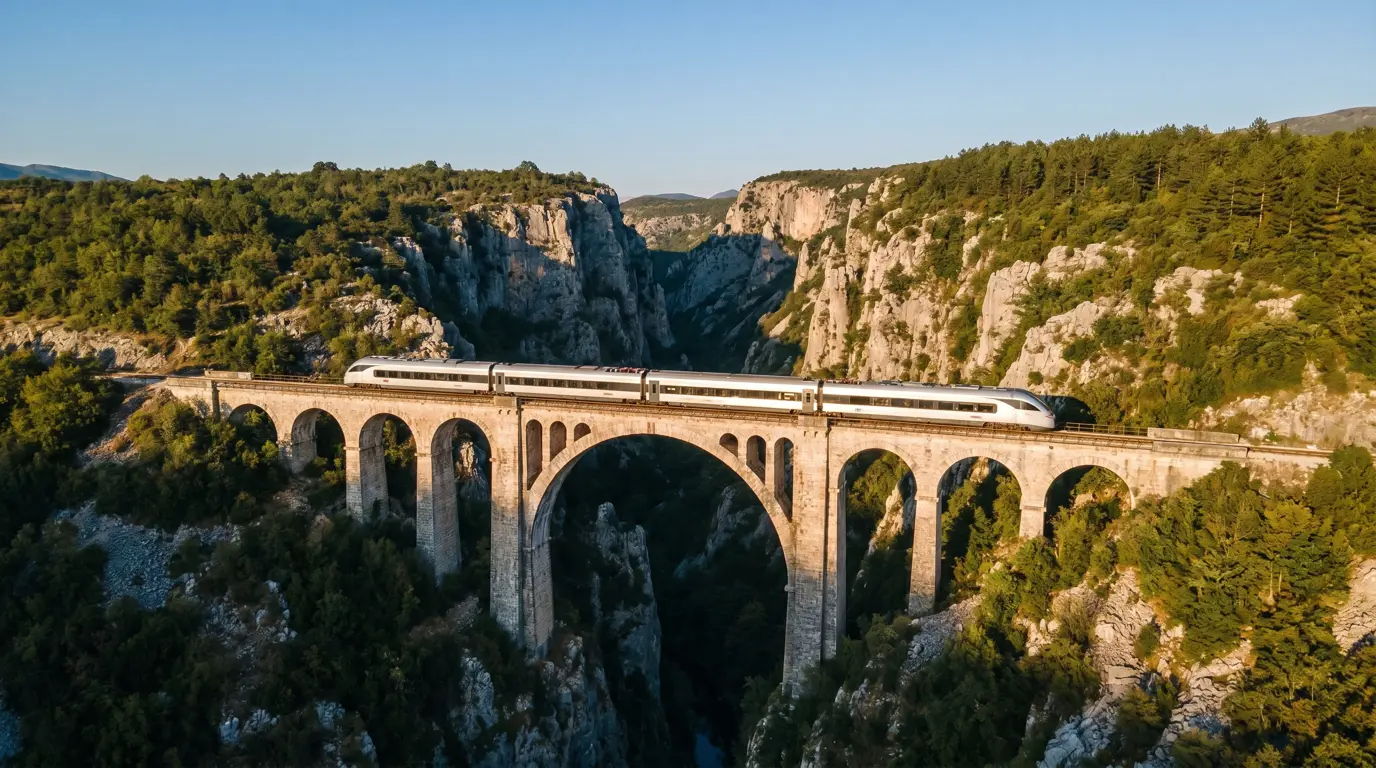
British Airways launched the first direct flight between London Heathrow and Montenegro on May 14, 2026 — three weekly services to Tivat through September. This is the UK flag carrier operating from its main hub, not a charter operation or budget airline. It brings Club Europe business class to the route for the first time and opens Avios booking to the UK buyer market. The Heathrow route serves a noticeably different travel demographic from traditional leisure-focused charter traffic.
Wizz Air opened its 36th global base at Podgorica Airport in March 2026, stationing two aircraft permanently and launching 14 new routes alongside existing services — 23 routes across 12 countries from Podgorica by summer 2026. That transforms the capital from a secondary option into a genuine year-round hub. For property owners managing a place in winter, contractors travelling between projects, or buyers making viewing trips outside the summer season, year-round connections from Hamburg, Paris, and Barcelona are now practical reality. Podgorica is 75 minutes from the Bay of Kotor.
Flydubai opens a daily Tivat–Dubai service from May 2026, creating a Gulf corridor with no precedent in Montenegro's aviation history.
More airlift expands tourism, supports rental occupancy, makes second-home ownership more practical, and — critically — widens the future resale audience. Property markets are not isolated from transport networks. The Bay of Kotor's beauty matters. So does whether a buyer from London, Berlin or Istanbul can realistically get there with minimal friction.
Then There Is Digital Infrastructure
This is often overlooked in property commentary, but for a growing segment of international buyers it is not optional.
They are not merely buying lifestyle. They are buying functional optionality — the ability to work from the property, run video calls reliably, operate a business, spend extended periods without feeling digitally stranded.
Montenegro's fibre coverage is already stronger than some outsiders assume. And Starlink adds another important layer. SpaceX's satellite internet service was confirmed by Montenegro's telecommunications regulator EKIP in February 2026 to be launching by the end of Q2 2026. For internationally mobile buyers, reliable connectivity is no longer a luxury feature. It is infrastructure. The ability to work from a remote villa, run video calls from a mountain property, or operate a business from a seasonal residence changes what it means to own here — and changes which locations are viable.
No single technology transforms a market. But the accumulation of improvements matters, and the direction here is consistent.

None of This Makes Montenegro Frictionless
This is where honest commentary must hold its ground.
Montenegro has real friction. Bureaucracy remains inconsistent. Administrative processes can be slower than foreign buyers expect. Planning frameworks vary meaningfully by municipality. Banking remains more cumbersome than many international clients would prefer, particularly in an era of heightened AML compliance. Legacy title issues exist in certain market segments. Documentation quality can vary. Infrastructure gaps remain, especially outside the main coastal corridor.
The domestic market is small and transaction volumes are thin relative to larger European markets, which means pricing signals can be volatile and should not be overstated. Administrative reform takes time to filter down to the level of daily property transactions.
This is not Switzerland. Nor should it be presented as such. Markets are not irrational to price these realities — part of Montenegro's appeal has historically reflected precisely this discount: beauty and opportunity paired with meaningful friction. The relevant question is not whether the problems exist. They do. The more interesting question is whether the overall trajectory is improving. At present, there is a credible case that it is.
Croatia Is the Obvious Comparison — Handled With Care
Every serious Montenegro discussion eventually arrives here. The lazy version says Montenegro is "the next Croatia." That phrase should be treated with suspicion. Markets rarely repeat neatly. Croatia's EU journey occurred in its own context, with its own economic base, political environment, tourism dynamics and investment history.
But the comparison remains useful in one specific respect: perception evolves.
There was a time when Croatia was viewed very differently by international buyers. Institutional integration, infrastructure improvements, airline connectivity, tourism maturity and increasing familiarity gradually changed that. Not overnight. Not linearly. But materially.
The lesson is not that Montenegro will replicate Croatia's path. It is that international perception can shift significantly when access, confidence and institutional alignment improve over time. Markets often respond to trajectory before completion.
What This Means for Property Buyers
The practical implications differ by buyer profile.
For second-home buyers, improved access, stronger infrastructure and deeper EU institutional engagement reduce perceived friction. That makes ownership feel more practical and future liquidity more credible.
For lifestyle relocators and globally mobile professionals, the combination becomes more compelling: good air access, improving digital resilience, European time zone, climate, and relative affordability compared with established Mediterranean alternatives. Montenegro's SEPA membership since October 2025 makes euro payments across much of Europe materially simpler and cheaper than before — a small but tangible example of convergence becoming practical rather than theoretical.
For investors, nuance matters more. Not all segments benefit equally. Well-located, legally clean residential stock in proven areas may become easier to understand and easier to resell as the market matures. Quality rental property in accessible destinations benefits directly from connectivity and tourism growth. Speculative land remains speculative land. Poor documentation remains poor documentation. Infrastructure optimism is not a substitute for due diligence. This is not a rising tide lifting every boat.
But selective markets often respond positively to broader confidence shifts. And right now the signals — institutional, financial, logistical — are converging in a way that has not been true before.
The Direction of Travel
The EU is not committing political capital, drafting accession treaties and releasing reform-linked funding in Montenegro out of sentiment. It sees value in anchoring the country more firmly within its institutional and economic orbit.
For internationally mobile buyers thinking about where to place capital, family time, or longer-term optionality, that institutional signal is worth weighing. Not as a guarantee — accession timelines have slipped before, and geopolitical variables remain outside Montenegro's control. But as a credible indication of direction.
Montenegro has spent twenty years building toward this moment. All 33 negotiating chapters are open. Fourteen are provisionally closed. The accession treaty is being drafted. The reform money is arriving. The airlines are landing. Starlink is switching on. Piece by piece, the conditions for a more connected, more credible market are taking shape.
International buyers do not need to be euro-federalists to find that interesting.
Related Reading

About the Author
Peter Flynn moved to Montenegro in 2005 and began working in the country's property market as a private speculator. He established New Territory DOO in 2006 to formalise his operations after the country gained independence. With two decades of experience guiding international buyers through Montenegro's property market and residency processes, he specialises in the Tivat and Bay of Kotor area. Working alongside business partner Maša Flynn, NT Realty (which takes its name from the New Territory holding company) has helped hundreds of buyers from the US, UK, Australia, and beyond navigate Montenegro's evolving legal and regulatory landscape. Peter maintains close working relationships with local lawyers, notaries, and government officials, providing clients with current, practical guidance rooted in on-the-ground experience.
In this article
Get luxury real estate updates directly in your inbox.
Are you interested in buying a home? Look no further than working with our real estate experts.

.avif)
.avif)
.avif)