
Reading Tivat’s Property Map: Lessons from Croatia’s EU Accession
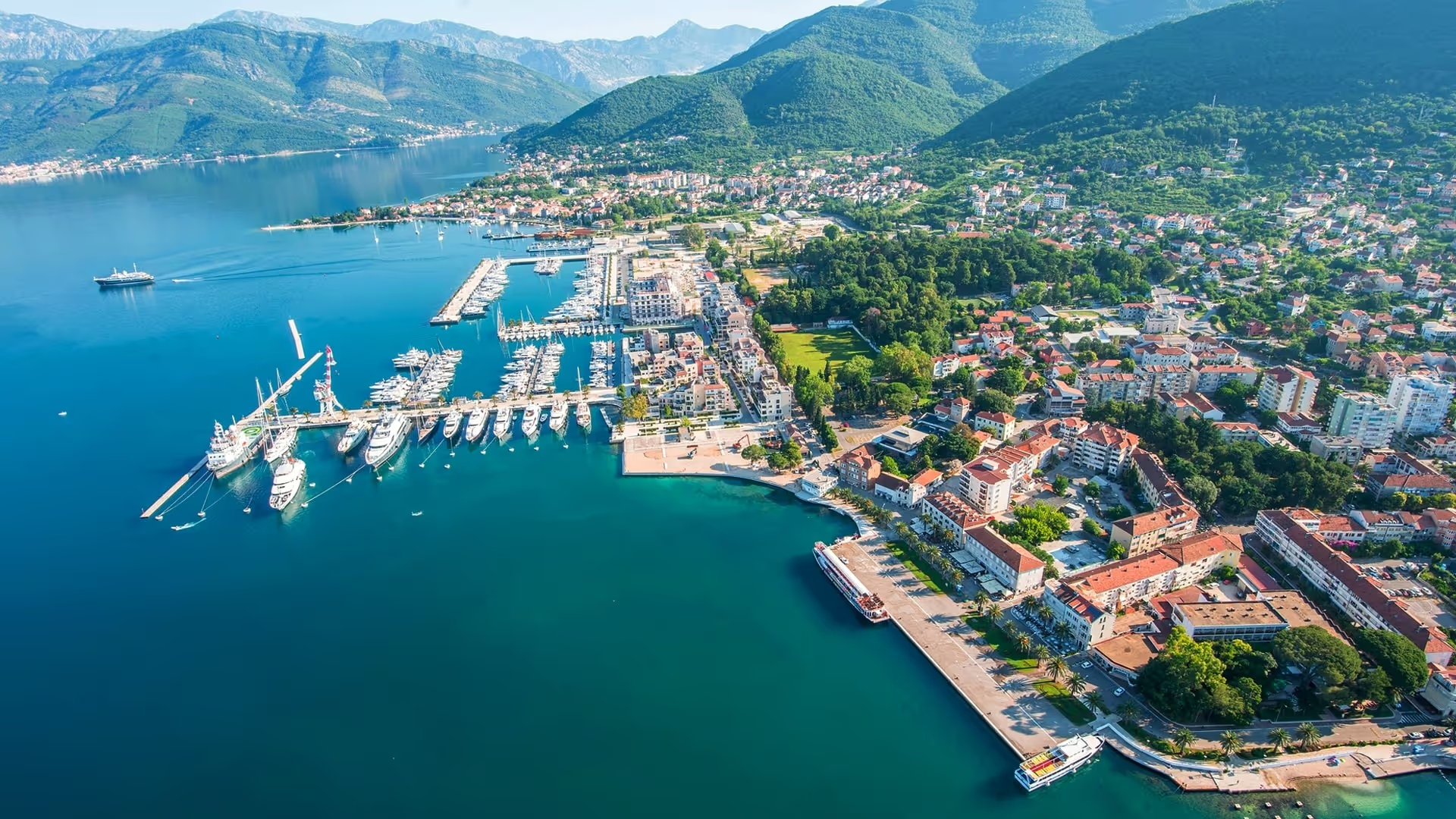
The neighborhoods immediately surrounding Porto Montenegro have consistently outperformed the complex itself. That pattern isn't random—it's how constrained coastal markets reprice once external risks compress.
That observation kept surfacing as I watched Tivat evolve over the past two decades. The conventional answer—location, location, location—explains some of it. But it misses something more subtle: the pattern of how growth spreads through a constrained coastal town once external risks begin to compress.
A few years ago, I started digging into Croatia's coastal property data from the period after EU accession in 2013. What I found wasn't what I expected. Split and Dubrovnik didn't just "rise with the tide"—specific neighborhoods repriced in a clear sequence, and the areas that delivered the strongest percentage returns weren't always the obvious ones.
That Croatian pattern maps onto Tivat almost perfectly.
What Croatia's Data Actually Shows
When people discuss Croatia's post-EU property growth, they tend to cite national averages. The headline number is impressive: Croatia's residential property price index roughly doubled between 2013 and 2025, rising from around 95 to over 200 (using the Bank for International Settlements benchmark, 2010=100).
But that national figure obscures what actually happened on the ground.
Growth didn't spread evenly. It concentrated in specific types of places—and within those places, in specific neighborhoods. The pattern was remarkably consistent across Split, Dubrovnik, and smaller coastal towns:
- Prime waterfront and historic cores reprice first—not from demand surge initially, but risk compression. EU accession reduced perceived legal, currency, and governance risks for international buyers and lenders. Areas that were already "finished" and liveable benefited immediately because that's where capital preservation instincts concentrated.
- Adjacent practical neighborhoods close the pricing gap—not the glamorous streets, but flat, walkable to the center, suitable for year-round living. In Split, this meant inner neighborhoods just outside Diocletian's Palace. In Dubrovnik, it meant streets behind the Old Town that locals had always preferred but tourists overlooked.
- Peripheral areas move last—and this is the part many investors missed. Genuinely peripheral areas only started moving later, once central supply had tightened and buyers began accepting trade-offs: further distance in exchange for newer construction, garages, and lower entry prices.
"This sequence matters far more than any percentage growth figure. It tells you where gains appear, when they appear, and why some areas outperform despite looking less attractive on paper."
This sequence matters far more than any percentage growth figure. It tells you where gains appear, when they appear, and why some areas outperform despite looking less attractive on paper.
Tivat follows this pattern almost exactly.
Mapping Tivat Through a Croatian Lens
If you overlay Croatia's coastal market behavior onto Tivat's geography, the town starts to make intuitive sense as a collection of micro-markets, each with its own timing and logic.
Donja Lastva: The Repricing That Already Happened
Donja Lastva, particularly its elevated sections like Perušine, represents Tivat's equivalent of Split's Bačvice waterfront or Dubrovnik's Lapad fringe—supply-constrained, lifestyle-driven, and globally recognized by international buyers.
This area has largely completed its repricing cycle. Growth here is steady rather than explosive. Land availability is minimal, projects are bespoke. Buyers aren't looking for value per se—they're investing in a specific location and lifestyle that can't be replicated elsewhere in Tivat.
The Croatian lesson: these areas reprice first and hold value best during downturns, but they're not where the highest percentage gains typically occur going forward. They've already moved.
Seljanovo and Kalimanj: The Established Core
Central Seljanovo—the streets radiating from Tivat's town center toward Porto Montenegro—and the small historic marina neighborhood of Kalimanj represent the town's liveable, walkable core.
In Croatian terms, this is equivalent to Split's inner neighborhoods just outside the ancient core: close to everything, practical for locals and expats alike, with a mix of older stock and newer renovations steadily raising the floor.
Seljanovo has been quietly upgrading for years. Newer builds set pricing benchmarks, and older apartments gradually close the gap. It's not dramatic, but it's persistent. Kalimanj, meanwhile, is tiny—a waterfront enclave with authenticity and scarcity that appeals to buyers seeking something less polished than Porto Montenegro but more characterful than a standard apartment block.
These areas don't usually deliver explosive growth, but they deliver consistency. In Croatia, equivalent neighborhoods maintained strong liquidity and steady appreciation throughout the post-EU cycle.
Tripovići and Mažina: The Quiet Outperformers
Here's where it gets interesting.
Tripovići sits just behind Tivat's center—close enough to walk to supermarkets and schools, far enough that it's always felt more local than international. Historically, it was mixed-use, unglamorous, the kind of place you'd drive through without noticing. We own a development plot there and are building our family home, not as speculation, but because the views over Tivat Bay are equally spectacular to Donja Lastva's, though the character is quieter and more residential.
Mažina, meanwhile, climbs the hillside east of town—residential, elevated, increasingly favored by buyers who want views and quiet but can't afford or don't want Donja Lastva's premium.
Neither area is particularly "prime" in the traditional sense. But Croatia's pattern suggests these are precisely the zones that often deliver the strongest percentage gains over a full cycle.
"They start cheaper, yet benefit disproportionately from proximity once core areas have repriced beyond affordability thresholds."
Why? Because they start cheaper, yet benefit disproportionately from proximity once core areas have repriced beyond affordability thresholds.
In Split, inner neighborhoods like those near Žnjan or transitional zones behind the waterfront often outperformed on a percentage basis—not because they became fashionable, but because pricing gaps compressed. Buyers who were priced out of Bačvice recalibrated what "acceptable" distance or elevation looked like, and these areas were suddenly reconsidered.
Tripovići and Mažina are Tivat's version of that dynamic. They're not fringe—they're structurally part of the town. And as Donja Lastva, Seljanovo, and Porto Montenegro's surrounding blocks continue to tighten, these neighborhoods become the logical next consideration for buyers who want to live in Tivat proper, not on its outskirts.
When we moved our agency from Kotor to Tivat years ago, it wasn't because of any Croatian analysis—it was because we could see Tivat becoming the epicenter for international buyers, with Porto Montenegro as the focal point. The Croatian data came later, and when I studied it, the pattern simply confirmed what we'd already observed on the ground: growth spreads outward from constrained cores in predictable waves.
Our office is in Kalimanj, we have holdings in Tripovići, and we've positioned in other areas like Luštica and Kalašin in northern Montenegro—always looking at where the ripple would travel next, not where it had already arrived.
Gradiošnica and the Airport Fringe: The Second Wave
Further out, toward the airport and into areas like Gradiošnica, the logic shifts entirely.
These zones are developer-led, car-dependent, and defined by new construction rather than established character. In Croatian terms, this is equivalent to eastern Split or peripheral Zagreb districts—places that grew not because of charm, but because central areas ran out of land.
Croatia's pattern shows these zones typically benefit later in the cycle, once:
- Central neighborhoods have meaningfully repriced
- Buyers accept infrastructure proximity (airports, roads) as a trade-off
- Supply constraints elsewhere make greenfield development the only option for volume
Gradiošnica isn't going to outperform Tripovići in the near term. But it's not irrelevant either. Once Tivat's core has fully tightened—which, given the town's physical constraints, seems increasingly likely—these expansion zones become the release valve for demand that can't be met elsewhere.
The Croatian precedent suggests this could be a medium-term story—five years or longer—rather than an immediate one. But it's worth watching.
Why Tivat's Constraints Make the Croatian Analogy Stronger
Tivat is physically boxed in.
To the west and south: Tivat Bay.
To the north: the airport and its operational constraints.
To the east: rising topography that quickly becomes impractical for large-scale development.
Porto Montenegro has locked up a significant portion of premium waterfront. Donja Lastva's hillsides are largely spoken for. Seljanovo is already dense.
This means growth pressure in Tivat can't express itself through sprawl. It has to express itself through:
- Densification in established areas
- Price compression between neighborhoods
- Eventual expansion into the few remaining greenfield zones
Croatia's coastal towns with similar constraints—Split hemmed in by mountains and sea, Dubrovnik constrained by topography and heritage protections—are precisely the ones that saw the strongest post-EU performance relative to national averages.
Tivat isn't just a town within Montenegro. It's a single, constrained coastal node with international legibility, infrastructure density (marina, airport, year-round services), and a buyer base that already skews heavily non-local.
"When you think about EU accession effects on Montenegro, it's more useful to think about how Tivat as a specific asset gets re-rated, rather than how 'Montenegro' as an abstract country performs."
When you think about EU accession effects on Montenegro, it's more useful to think about how Tivat as a specific asset gets re-rated, rather than how "Montenegro" as an abstract country performs.
What This Means Looking Forward
If Croatia is the guide—and I believe it's the best available guide—the next three to five years in Tivat will likely see:
- Continued strength in the established core: Donja Lastva, central Seljanovo, and Kalimanj will remain liquid, low-volatility holdings. Growth will be steady rather than spectacular, but these areas provide downside protection and predictable appreciation.
- Compression in overlooked areas: Tripovići and Mažina are the zones to watch for percentage gains. They won't double overnight, but as pricing gaps close and buyers recalibrate what "acceptable" means, these neighborhoods should steadily reprice upward. This is where Croatia's pattern suggests the most interesting risk-adjusted returns typically emerge.
- Slower movement on the periphery: Gradiošnica and similar zones will benefit eventually, but they're second-wave. They'll matter once central supply has genuinely exhausted itself and buyers accept edge locations in exchange for modern construction and lower entry prices.
The mistake many investors make is assuming growth happens everywhere simultaneously once a catalyst like EU accession occurs. Croatia's experience shows that's not how it works. Growth radiates outward from constrained, internationally legible cores, and it does so in a sequence that's surprisingly predictable.
Meanwhile, Montenegro's current building permit reset is temporarily constraining new coastal supply—adding another layer to the supply-demand dynamics that will shape pricing in the years ahead.
The question for buyers now is not just which neighborhood, but which phase of the cycle each neighborhood sits in—and that's a question improving aviation access to the Bay of Kotor is helping to accelerate.
A Final Thought
I've now been working in Montenegro's property market for two decades—since before the country even gained independence. I've watched Tivat evolve from a quiet town with a failing shipyard into a globally recognized marina destination. I've seen Donja Lastva's hillsides transform from agricultural land into some of the Bay's most sought-after addresses.
What strikes me most about Tivat today is how closely it mirrors the setup Croatia's best-performing coastal markets had in the years leading up to EU accession: constrained supply, international demand, infrastructure in place, and a clear hierarchy of neighborhoods that haven't yet fully repriced relative to each other.
The Croatian lesson isn't that everything will rise. It's that specific places rise first, and specific dynamics—proximity, walkability, scarcity—determine which neighborhoods benefit most and when.
Tripovići may not have Donja Lastva's views or Porto Montenegro's brand recognition. But it has something equally valuable: it's close, it's liveable, and it's still affordable relative to the core.
That combination, in Croatia, proved to be remarkably powerful.
The broader shift in how people choose where to live—the repricing of place around life quality rather than employment proximity—is only reinforcing these dynamics. For buyers who understand which residency pathways remain open, the opportunity to position in the right Tivat neighborhood before the next repricing wave is still available.

About the Author
Peter Flynn moved to Montenegro in 2005 and began working in the country's property market as a private speculator. He established New Territory DOO in 2006 to formalise his operations after the country gained independence. With two decades of experience guiding international buyers through Montenegro's property market and residency processes, he specialises in the Tivat and Bay of Kotor area. Working alongside business partner Maša Flynn, NT Realty (which takes its name from the New Territory holding company) has helped hundreds of buyers from the US, UK, Australia, and beyond navigate Montenegro's evolving legal and regulatory landscape. Peter maintains close working relationships with local lawyers, notaries, and government officials, providing clients with current, practical guidance rooted in on-the-ground experience.
In this article
Get luxury real estate updates directly in your inbox.
Are you interested in buying a home? Look no further than working with our real estate experts.

.avif)
.avif)
.avif)