
The temporary supply shock that could make Montenegro’s coastal market even stronger
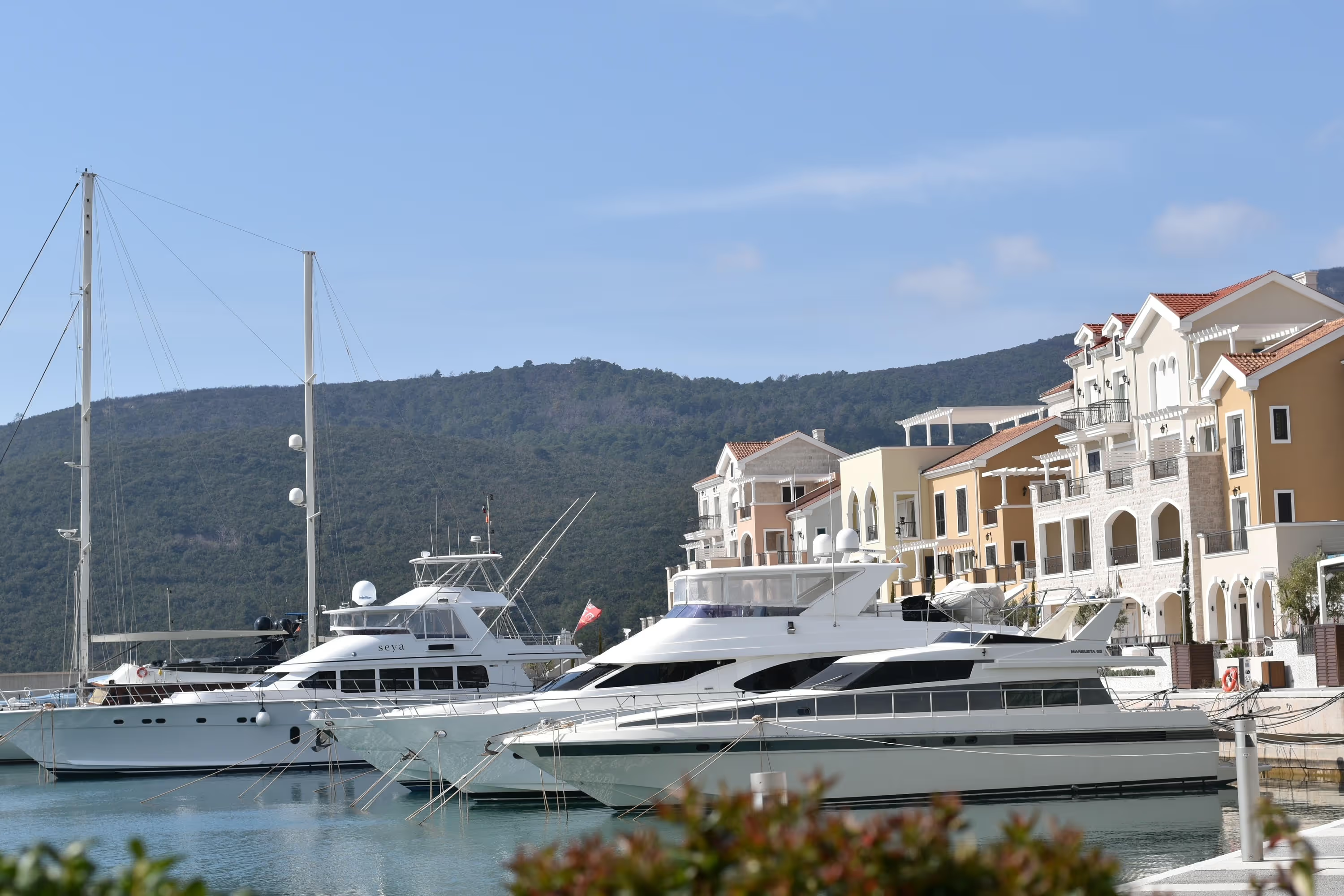
Montenegro's building permit approvals collapsed 82% year-on-year in Q2 2025 — falling from 55 permits to just 10 — yet property prices surged 18.7% nationally in 2024 and have moved decisively above €2,000 per square metre in 2025.
This isn't a contradiction. It's a signal.
While the headline numbers suggest a construction freeze, the underlying dynamics point to something more strategic: a regulatory reset that's temporarily restricting supply while foreign buyer interest, investment capital, and construction capacity remain intact.
Most importantly, Montenegro's government just made a quiet but telling decision about what comes next.
A regulatory overhaul seven years in the making
In March 2025, Montenegro replaced its 2017 "notification-based" construction system with mandatory building permits aligned to EU directives. The shift wasn't optional — it was required for EU membership by 2028.
The old system allowed developers to begin construction after a simple administrative notification. The new framework requires full municipal approval, environmental assessments, and compliance verification before ground is broken.
The result was predictable: a bottleneck.
Permits plunged in Q2 2025 as municipalities adjusted to decentralised authority (projects under 3,000 square metres now fall to local councils), developers navigated unfamiliar approval processes, and the digital e-permit system remained in development.
But by Q3 2025, permits had already rebounded to 265 — a clear sign that the collapse was procedural, not structural. Dwelling permits for the first three quarters of 2025 remained down 36% year-on-year, but the trajectory stabilised. The system is learning.
The question isn't whether Montenegro's construction sector will recover — it will. The question is what happens when it does.

What flat labour quotas reveal about strategic priorities
In December 2025, Montenegro's government adopted the 2026 foreign worker quota at approximately 29,000 positions — essentially unchanged from 2024 and 2025.
At first glance, this looks unremarkable. But in the context of regional labour market volatility, it's anything but.
Croatia is actively tightening labour access through new language requirements introduced in 2026, even as its construction sector contracts (building permits down 28% year-on-year in 2025). Greece announced plans to recruit 360,000 foreign workers in 2025 but managed to mobilise just 90,000 — a 75% shortfall that reveals systemic recruitment failure. Spain is approaching labour market saturation with 3.12 million foreign workers (14.1% of the workforce) and is now regularising 900,000 undocumented migrants. Portugal has pivoted toward digital nomads and skilled workers, moving away from construction labour altogether.
Montenegro, by contrast, is holding the line.
The 2026 quota preserves access to approximately 29,000 foreign workers — primarily in accommodation and food services, construction, and professional services — at a moment when the country's regulatory infrastructure is being upgraded but execution capacity needs to remain intact.
This isn't a passive decision. It's a signal that the government expects construction demand to return once permit processes normalise in late 2026 or early 2027, and it's ensuring the labour supply will be there when projects move forward.
Foreign workers now represent approximately 11.1% of Montenegro's workforce — higher than Croatia (6.7%) and Greece (6.7%), but below Spain (14.1%) and Portugal (11.6%). The difference is that Montenegro's quota reflects planned absorption capacity, not uncontrolled inflows or mobilisation failures.

The message is clear: Montenegro isn't restricting supply. It's maintaining execution capacity during a regulatory transition.
Why Croatia's slowdown is not Montenegro's slowdown
Croatia's building permit decline tells a different story.
Permits fell 14% overall in 2025, with construction-specific permits down 28% year-on-year. But Croatia's slowdown isn't regulatory — it's demand-driven.
Tourism prices in Croatia have surged more than 50% since 2022, compared to roughly 20% increases in competing Mediterranean destinations, according to data from the Croatian Central Bank. International buyer interest has cooled as Croatia's coastal markets price themselves beyond key demand segments.
Croatia's government is reinforcing this trend by tightening labour access through new language requirements in 2026, even as construction activity contracts. The permit slowdown and labour restrictions are moving in the same direction — a coordinated retreat, not a temporary bottleneck.
Montenegro's situation is structurally different.
Permit restrictions are regulatory, not demand-driven. Prices continue rising across all segments — from national averages (€2,000+ per square metre) to prime coastal markets in Tivat and Kotor (€3,500–€5,000 per square metre based on achieved transaction prices), to exclusive developments like Porto Montenegro and Luštica Bay (approximately €10,000 per square metre), to ultra-premium offerings exceeding €20,000 per square metre.

Even Podgorica's high-end market is approaching €4,000 per square metre — a figure that would have seemed implausible three years ago but now reflects Montenegro's EU accession momentum and the capital city's infrastructure improvements.
Foreign buyer interest remains robust across all price tiers. Investment capital continues flowing into coastal projects. Construction labour capacity is being preserved through flat quotas.
The difference is execution timing, not market fundamentals.
What this means for 2027-2028
Markets that are upgrading their foundations while maintaining execution capacity tend to emerge stronger than markets that are restricting both simultaneously.
Montenegro is upgrading its regulatory infrastructure to EU standards — a requirement for membership, not a policy choice. That creates short-term friction. But the decision to maintain foreign worker quotas at 29,000 positions signals confidence that construction demand will return once permit processes stabilise.
The setup for 2027-2028 is straightforward: pent-up demand from delayed projects, normalised permit approvals under the new EU-aligned system, preserved labour capacity to execute those projects, and continued foreign buyer interest in a market that remains competitively priced relative to Croatia, Greece, and Spain.
By contrast, Croatia is experiencing coordinated tightening (falling permits, rising costs, labour restrictions), Greece is failing to mobilise the workers it needs, Spain is approaching saturation, and Portugal has moved away from construction-focused immigration.
Montenegro's permit collapse isn't a crisis. It's a reset — and the government's labour quota decision suggests it knows exactly what's coming next.
The value of boring
The most interesting thing about Montenegro's 2026 labour quota decision is how unremarkable it appears.
No dramatic expansion. No sudden contraction. Just continuity.
But in a region where Croatia is tightening, Greece is failing to deliver, Spain is absorbing undocumented inflows, and Portugal is pivoting away from construction labour, continuity is a strategy.
Montenegro is maintaining the capacity to build at the exact moment its regulatory infrastructure is being upgraded to EU standards. That's not accidental. It's positioning.
Markets don't reward volatility. They reward predictability, execution, and the ability to deliver when conditions improve.
Montenegro's coastal property market is undergoing a supply shock, but it's a temporary one — driven by regulatory modernisation, not demand weakness. The labour quota decision confirms that the government expects this to resolve, and it's ensuring the workforce will be ready when it does.
For investors evaluating Southern Europe's coastal markets in 2026, the question isn't whether Montenegro's permit approvals will recover. It's whether you're positioned for what happens when they do.

About the Author
Peter Flynn moved to Montenegro in 2005 and began working in the country's property market as a private speculator. He established New Territory DOO in 2006 to formalise his operations after the country gained independence. With two decades of experience guiding international buyers through Montenegro's property market and residency processes, he specialises in the Tivat and Bay of Kotor area. Working alongside business partner Maša Flynn, NT Realty (which takes its name from the New Territory holding company) has helped hundreds of buyers from the US, UK, Australia, and beyond navigate Montenegro's evolving legal and regulatory landscape. Peter maintains close working relationships with local lawyers, notaries, and government officials, providing clients with current, practical guidance rooted in on-the-ground experience.
In this article
Get luxury real estate updates directly in your inbox.
Are you interested in buying a home? Look no further than working with our real estate experts.

.avif)
.avif)
.avif)