
Montenegro 2026: The Pre-Accession Window Every Serious Investor Should Understand
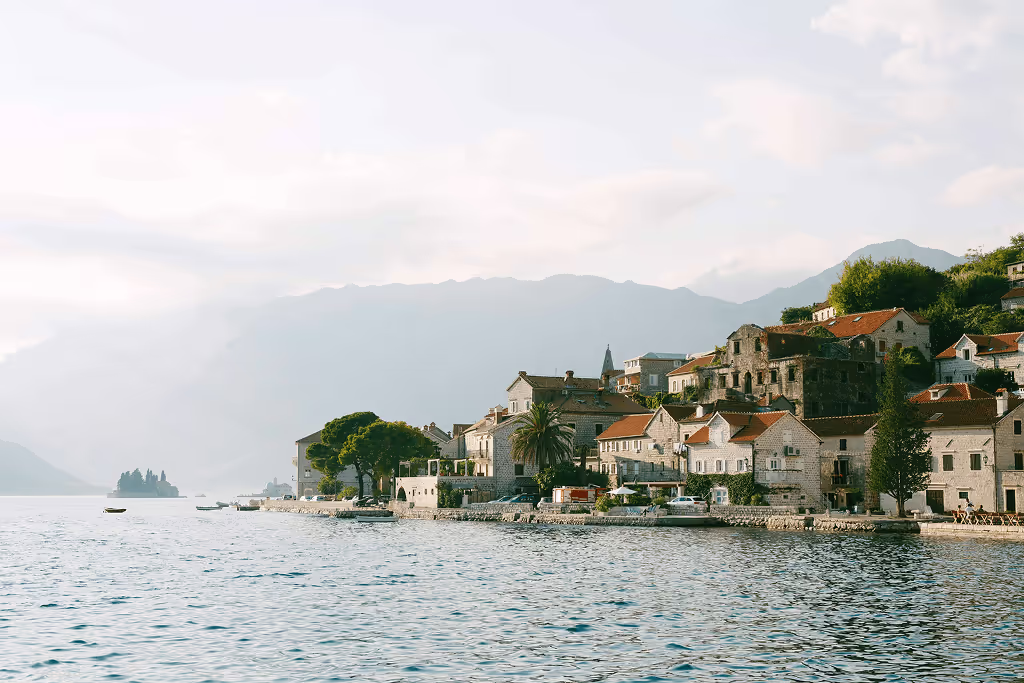
There's a particular moment in a country's EU journey that creates asymmetric opportunity. Not the frontier phase when everything's uncertain. Not after accession when everyone's already positioned. But the window when negotiations close, membership becomes inevitable, and prices haven't yet fully adjusted to their European valuation.
Montenegro is entering that window now.
In 2005, I moved here as a property investor months before Montenegro's independence referendum. The constitutional momentum was building, international recognition was inevitable, and you could feel the shift coming if you were paying attention. By the time independence formalized in 2006, those of us who positioned early had captured substantial appreciation as the country opened up and coastal property values adjusted to the new reality.
Twenty years later, I'm watching the same dynamic unfold - but this time it's EU accession with a defined 2026-2028 timeline, and the window is narrower than most people realize. Here's why the next 18 months matter, what Croatian coastal property actually tells us, and why mid-market buyers around Tivat need to understand they're running out of time to position at current prices.
What Croatian Coastal Property Actually Shows Us
Everyone quotes the comfortable statistic: "Croatian property up 79.6% since 2013 EU accession." That's the national figure - Zagreb apartments, inland towns, everything blended together. Accurate but not particularly useful if you're looking at coastal markets.
The verified data for Croatian coastal property tells a more specific story. Since Croatia's 2013 EU membership, the national market has appreciated 68-74%, with the most dramatic acceleration in recent years. In 2024-2025, coastal hotspots are recording annual growth of 10-13% - more than a decade after joining the EU.
Dubrovnik, Croatia's premier coastal city, saw approximately 60% appreciation in the five-year period from 2020 to 2025 alone, with the most intense growth occurring between 2020-2023 when annual increases hit 10-15%. Split, as Croatia's second-largest city and a major coastal hub, now trades at €4,000-7,000 per square meter - prices that would have seemed implausible a decade ago.
The pattern isn't a single accession spike followed by normalization. It's sustained revaluation as European buyers recognize Croatia as a legitimate EU coastal option rather than emerging market risk with nice beaches. In Q2 2025, Croatia recorded 13.2% year-on-year growth, ranking among the EU's top five performers alongside Portugal, Bulgaria, Hungary, and Spain.
What this tells us about Montenegro is straightforward: EU membership triggers a fundamental repricing in how international buyers perceive coastal property markets. Not speculation about future potential, but recognition of current European status.
Montenegro is about to follow this trajectory. All 33 EU negotiation chapters are open, seven provisionally closed, with the government targeting closure by end 2026. EU Enlargement Commissioner Marta Kos has stated Montenegro could conclude negotiations in 2026, with membership following in 2027-2028. Brussels explicitly confirms Montenegro as "on track" - the most advanced Western Balkan candidate.
The question for investors isn't whether Montenegro joins the EU. It's whether you position before negotiation closure triggers the recognition phase, or wait until everyone else has processed what's happening.
Why Montenegro's Trajectory Could Match Croatia's
Montenegro brings several advantages Croatia didn't possess in 2013, which is why simply assuming "Montenegro will follow Croatia" actually understates the opportunity.
Porto Montenegro operates as the world's only Platinum-designated super yacht marina - a technical classification awarded by The Yacht Harbour Association, not marketing language. Croatia has quality marinas along its coast; Montenegro has the Adriatic's defining luxury anchor. That distinction matters to a specific category of buyer and creates infrastructure Croatia never replicated at scale.
The tax structure is more competitive: 9% corporate tax and territorial taxation for non-residents, meaning foreign-source income remains untaxed in Montenegro. Croatia's regime is less flexible and offers fewer advantages to international wealth structuring.
Geographic diversity provides something unique in the Adriatic: you can be on Kotor Bay in the morning and skiing Kolašin or Žabljak in the afternoon. Two and a half hours from sea to ski, from yacht to mountain. Croatia's coastal regions offer beach or mountains, not both in comfortable proximity. For active ultra-high-net-worth buyers, that combination creates genuine differentiation.
There's also an established international community that goes beyond tourism. Vitalik Buterin, Ethereum's founder, is rumored to have residence at Luštica Bay. Regular ultra-high-net-worth presence in the Porto Montenegro area. Montenegro positioned itself as the Adriatic's lifestyle destination during the 2010s while Croatia was still primarily tourist-focused, and that positioning has held.
Yet despite these advantages, current pricing tells an interesting story:
Croatian Dalmatian coast quality property: €8,000-12,000/sqm
Montenegro Tivat area comparable quality: €4,000-6,000/sqm
A 30-50% discount for arguably superior infrastructure and demonstrably better tax treatment - before EU membership crystallizes the comparison in international buyers' minds. This is the pricing arbitrage that closes once Montenegro's accession becomes mainstream recognition rather than specialist knowledge.
The Mid-Market Reality: Where Accessible Opportunity Still Exists
The headlines naturally focus on Porto Montenegro's Marina Village at €8,000-15,000 per square meter, or Luštica Bay's fairway villas in the €2.5M-4.5M range. That's where the luxury market operates, but it's not where volume transactions happen or where most international buyers with €300,000-700,000 can actually position.
The accessible opportunity sits in quality Tivat-area locations that benefit from proximity to infrastructure without carrying the premium pricing. Understanding which Tivat neighborhoods are positioned for the strongest gains requires looking at how Croatian coastal markets repriced after accession — a pattern that maps onto Tivat's geography with remarkable precision.
Donja Lastva offers exactly this positioning - close enough to Porto Montenegro to benefit from the marina's presence, accessible enough to avoid the ultra-premium valuation. Pricing typically runs €4,000-5,500 per square meter depending on specific location and sea access.
Seljanovo, Podkuk, Mažina, Tripovići, and Kalimanj represent prime coastal access in the broader Tivat area. These aren't secondary locations hoping for development; they're established communities with proper infrastructure trading at €4,000-6,000/sqm for quality property. An 80-100 square meter apartment runs €320,000-600,000 - accessible for international buyers but positioned to benefit from the same EU accession dynamics that will reprice the broader market.
The up-and-coming areas deserve attention as well. Kava, Mrčevac, Dumidran, and Bonići are developing their infrastructure and appeal, offering entry points in the €3,500-4,500/sqm range. From these areas, you transition naturally to the mountainside of Kavač, which delivers wide views over Tivat Bay and what locals correctly describe as outstanding sunsets. Not waterfront premium, but genuine lifestyle appeal at more measured pricing.
The Luštica Peninsula more broadly retains authentic character while offering development potential and coastal positioning. Less developed than the immediate Tivat area but precisely because of that, offering opportunities for buyers who understand that Montenegro's EU trajectory will eventually bring capital and attention to quality coastal locations currently priced as "nice but secondary."
Where waterfront property exists with genuinely clean documentation, pricing runs €6,000-10,000 per square meter. Stock is limited and requires serious due diligence, but for buyers who can navigate the documentation requirements, waterfront at these levels represents value relative to comparable Croatian coast.
This remains accessible in 2025-2026. The question is how long these pricing levels persist once negotiation closure scheduled for end 2026 shifts Montenegro from "EU candidate making progress" to "imminent member state" in international buyers' perception.
What EU Accession Actually Does to Property Markets
The Croatian experience provides a framework for understanding the mechanics, not just the headline appreciation figures.
When Croatia joined the EU in 2013, international buyers didn't suddenly discover the country existed. They'd been visiting for years. What changed was perception of risk. "Croatian coastal property" moved from "emerging market with documentation uncertainty" to "EU member state with standardized legal framework."
That shift affected pricing in stages. Initial recognition as negotiations closed. Acceleration during the pre-membership year as formal accession approached. A spike in the actual accession year. Then sustained appreciation as European buyers processed Croatia as a legitimate alternative to overpriced French Riviera or Italian coast.
The appreciation wasn't uniform. Zagreb and inland areas saw moderate gains. Coastal hotspots - Dubrovnik, Split, the islands - saw the strongest performance because international buyers weren't looking for Croatian property generally. They were looking for Mediterranean coastal access at reasonable value with EU legal protections.
Montenegro will follow this pattern with one important difference: the window is more compressed because the setup is more obvious.
In 2013, Croatia was pioneering EU membership for Adriatic coastal states. Montenegro in 2026-2028 is following proven precedent. International buyers who positioned early in Croatian coast captured the full appreciation cycle. Those who waited until "everyone knew" paid post-recognition prices.
The same dynamic will play out in Montenegro, but faster because the Croatian precedent exists and sophisticated buyers understand the pattern. Once negotiation closure is announced, once mainstream financial media runs features on "Montenegro set to join EU in 2028," once German and Austrian and Italian buyers process that Montenegro will offer the same legal framework as Croatia but with superior marina infrastructure and better tax treatment - the obvious opportunities get absorbed quickly.
Quality Tivat apartments under €500,000. Properties with clean documentation in prime areas. Anything offering genuine coastal access with proper infrastructure. These won't stay available at current pricing once the broader market recognizes what's coming.
SEPA Changes the Infrastructure Reality
Since October 2025, Montenegro has been an operational member of the Single Euro Payments Area. For anyone who's wired money internationally for property transactions, the difference is transformative.
Previously, SWIFT transfers were the only option: slow settlement, unpredictable intermediary bank fees, €30-50+ per transaction, three to five day processing. For a property purchase requiring multiple wires - deposit, completion payment, legal fees, various transaction costs - the friction added up.
Under SEPA, transfers to €20,000 cost €1.99. Larger amounts are capped at €25 regardless of size. Settlement happens next business day. No intermediary banks. No surprise fees. Standard European payment infrastructure.
For a €450,000 property purchase, the improvement is concrete: previously €150-300 in wire costs across multiple transactions; now €25 total. More importantly, Montenegro no longer feels "offshore" from a banking and payments perspective. It operates on the same rails as any EU member state.
This matters because it removes a layer of friction that previously made Montenegro feel like it required specialist handling. SEPA membership is part of the broader EU integration process, and it's already operational rather than promised for some future date. For international buyers used to European banking standards, Montenegro now functions like any other euro-using market.
The Practical Framework
New regulations have clarified the residency pathway through property investment: €200,000 minimum purchase qualifies for residency application. This doesn't mean you need residency to buy property - foreign buyers can purchase freely - but if residency is desired, €200,000 establishes the threshold.
The alternative company structure for residency requires three employees, two of whom must be Montenegrin citizens. This is part of EU labor market alignment and ensures that residency isn't simply purchased without genuine economic contribution. For some buyers, particularly those planning actual business operations in Montenegro, this structure makes sense. For pure property investment, the direct property route is simpler.
Annual property tax runs 0.25-0.5% of official property value depending on location and property type. For a €400,000 property, that translates to €1,000-2,000 annually - low by European standards though it may adjust toward EU norms over time as fiscal harmonization occurs. Conservative investors should model potential increases, but current rates remain very manageable.
Transaction costs on purchase follow a stepped structure: new property purchased directly from developers carries 0% purchase tax. Resale property incurs 3%, 5%, or 6% depending on price thresholds. Legal fees, notary costs, and registration add another 2-3% combined. For a €450,000 purchase, budget roughly €20,000-35,000 in transaction costs depending on whether the property is new or resale.
Due diligence is non-negotiable. Work with experienced local advisors or legal counsel - and understand that knowledgeable real estate agents who've operated in Montenegro for years can provide valuable guidance alongside formal legal representation. Verify clean title at the cadastre. Confirm planning permissions are in order. Ensure utility connections exist and function. Check that building permits were properly obtained and match actual construction.
Montenegro is EU-track and improving its documentation standards, but it's not yet at the level of mature EU markets. Properties that look perfect in photos can have title complications or planning violations that create serious problems. Don't buy remotely based on listings and virtual tours. Visit the property. Walk the neighborhood. Meet the sellers if possible. Understand what you're actually purchasing.
The sweet spot for most international buyers sits between €300,000-700,000. This is where quality coastal access remains possible, where documentation tends to be cleaner (newer properties with modern standards), and where transaction volumes create reasonable liquidity for eventual exit.
Managing the Downside
EU accession timelines can slip. Political consensus that exists today may fracture. Economic shocks can disrupt property markets regardless of fundamental trajectory. These aren't hypothetical concerns; they're realities that conservative investors model into their assumptions.
Even if membership delays to 2029 rather than 2028, Montenegro's fundamental appeal - Mediterranean climate, Adriatic coast, quality marina infrastructure, competitive tax regime - remains intact. EU membership amplifies these advantages but doesn't create them. Properties in prime Tivat locations will retain value even if the accession timeline extends.
The economic concentration risk is real. More than 50% of foreign direct investment currently flows into real estate. If European buyers pause, American demand softens, and Turkish investment slows simultaneously - all possible in a global slowdown - correction risk exists. This argues for focusing on locations with multiple demand drivers: year-round rental potential, established expat communities, genuine lifestyle appeal beyond pure investment speculation.
Fiscal pressures are on the IMF's radar. The fund flags widening deficits and an 18% current-account gap - not immediate crisis signals, but warnings that argue for conservative assumptions about economic growth and property demand sustainability. Montenegro isn't immune to European economic cycles, and EU membership doesn't guarantee perpetual growth.
Regulatory evolution is inevitable. EU alignment means stricter beneficial ownership disclosure, more rigorous rental income reporting, potentially higher property taxation over time as Montenegro harmonizes with European fiscal norms. Current property taxes of 0.25-0.5% could move toward 1-2% EU averages. For a €400,000 property, that's an increase from €1,000-2,000 annually to potentially €4,000-8,000. Not catastrophic, but worth modeling.
The market has already matured significantly. Coastal prices are up 70-100% in premium areas over the past five years. Montenegro isn't undiscovered. Future appreciation will be more measured than the recent explosive growth. Realistic investors should model 6-8% annual appreciation rather than 10-15%, treat anything above that as upside, and focus on properties that deliver rental income and lifestyle value regardless of capital gains.
The 2026 Inflection Point
Montenegro's government targets closing all negotiation chapters by end 2026. That's the trigger point where perception shifts from "making progress toward EU membership" to "imminent member state."
When closure is announced, several things happen in sequence. International financial media coverage intensifies: features in the Financial Times, Bloomberg, Wall Street Journal about Montenegro completing its accession process. Analysis pieces examining what this means for investment flows, property markets, tourism development.
Western European buyers - Germans, Austrians, Italians, French, Dutch - begin processing Montenegro not as interesting frontier opportunity but as about-to-be-fellow EU member at 30-50% discount to comparable Croatian coast. The psychological shift from "emerging market risk" to "European peer" happens quickly once the formal barriers are clearly falling.
Price discovery on the most obvious opportunities accelerates. Quality Tivat apartments under €500,000 with clean documentation. Properties in Donja Lastva, Seljanovo, prime coastal areas that offer genuine access without ultra-premium pricing. Anything with proper infrastructure that international buyers can underwrite using standard European property analysis.
By the time formal membership occurs in 2027-2028, the repricing has largely happened. You're buying at post-recognition prices rather than pre-recognition opportunity.
I watched this pattern play out with Montenegro's 2006 independence. There was a window between referendum announcement and execution when positioning was still possible at pre-independence pricing. Once independence formalized and international recognition was complete, that window closed. Properties that traded at X in early 2006 were worth significantly more by 2007, not because anything physical changed about them but because international perception shifted.
The EU accession window operates on similar logic but with more compressed timing. Roughly 12-18 months from now until negotiation closure. That's not multiple years of research time. That's one or two property visits, one or two decision cycles, and you're either positioned or you're watching the opportunity reprice itself in real time.
A Personal Perspective
I established New Territory in 2006, right after Montenegro's independence, and have worked every aspect of this market since - from frontier conditions when documentation standards were inconsistent and banking was rudimentary, through the gradual professionalization of the market, to today's EU candidacy with operational SEPA payments and clear accession timeline.
The parallel between 2005-2006 independence and 2026-2028 EU accession is clear. But there's one critical difference that makes the current opportunity both easier to execute and harder to capture.
In 2005, the referendum outcome carried genuine uncertainty. Would Montenegrins actually vote for independence? Would Serbia accept the result? Would international recognition follow smoothly? The infrastructure was frontier-level - limited banking, no payment systems, inconsistent legal frameworks. You needed conviction about an uncertain political process and tolerance for emerging market execution risk.
In 2026, those uncertainties don't exist. SEPA is operational. The EU timeline is documented with Brussels backing. Montenegro's "on track" status is confirmed by the European Commission, not hoped for by local politicians. Croatian precedent shows exactly what happens to coastal property markets during EU accession - 68-74% national appreciation, coastal hotspots growing 10-13% annually over a decade post-membership.
The setup is more obvious, which paradoxically makes the window narrower. In 2005, you needed to believe in something most people couldn't see clearly. In 2026, you just need to act before everyone else processes what's already becoming apparent.
If you believe Montenegro's 2027-2028 EU membership is credible - and Brussels confirms it is. If you believe Croatian coastal precedent is relevant - and the verified data shows 68-74% appreciation post-accession with sustained 10-13% annual growth in coastal hotspots. If you believe Montenegro's advantages in marina infrastructure, tax regime, and geographic diversity matter to international buyers. If you believe quality Tivat-area property at €4,000-6,000/sqm represents value versus comparable Croatian coast at €8,000-12,000/sqm.
Then the logic is straightforward: position in 2026 before negotiation closure, not afterward when the opportunity has repriced itself and mainstream awareness has eliminated the information arbitrage.
Or wait until Montenegro's EU membership is established fact, international media coverage is comprehensive, and prices reflect what everyone already knows. That's a perfectly rational choice - you'll be buying into a mature EU market with full legal protections and zero execution risk.
But you'll be paying post-recognition prices for that certainty.
You're Here for a Reason
You're reading this article because somewhere, perhaps not entirely consciously, you recognize the setup.
The questions are straightforward: Do you believe Montenegro joins the EU by 2028? Brussels says yes, explicitly confirming Montenegro as the most advanced candidate. Do you believe Croatian coastal precedent matters? The verified data shows 68-74% national appreciation post-accession, with coastal hotspots growing 10-13% annually. Can you act before end-2026 negotiation closure shifts international perception?
If the answers align, the opportunity is accessible. Quality Tivat-area property in the €300,000-700,000 range. Locations like Donja Lastva, Seljanovo, Podkuk, Mažina - areas with proper infrastructure benefiting from Porto Montenegro proximity without ultra-premium pricing. The mountainside of Kavač with its Tivat Bay views and remarkable sunsets. The Luštica Peninsula's authentic coastal character.
These opportunities exist now at pre-recognition pricing. The question is whether they'll still be available at these levels 18 months from now when negotiation closure makes Montenegro's EU trajectory obvious to broader international buyer base.
What's also shifting is how people reach Montenegro. A step-change in aviation connectivity — including Wizz Air's Podgorica base and British Airways' first Heathrow–Tivat route — is making the coast accessible from more European cities than ever before. Meanwhile, the broader shift toward lifestyle-driven property decisions is bringing a new cohort of buyers who prioritize quality of life over proximity to employment hubs.
On the supply side, a temporary building permit reset is constraining new coastal stock at precisely the moment demand is expanding — a dynamic that adds urgency to the timing question.
For discussion of specific properties and opportunities in the €200,000-800,000 range around Tivat, Luštica Peninsula, and prime coastal areas - before end-2026 negotiation closure - we should talk. Not because time is running out in some artificial scarcity way, but because the information arbitrage that exists when Montenegro's EU accession is specialist knowledge rather than mainstream awareness doesn't last indefinitely.
Markets are efficient over time. Right now there's a window where Montenegro's imminent EU membership is documented fact that hasn't yet fully priced itself into coastal property values. That window closes when everyone else figures out what's already becoming clear to those paying attention.
You're here for a reason. The window is open. It closes end of 2026.

About the Author
Peter Flynn moved to Montenegro in 2005 and began working in the country's property market as a private speculator. He established New Territory DOO in 2006 to formalise his operations after the country gained independence. With two decades of experience guiding international buyers through Montenegro's property market and residency processes, he specialises in the Tivat and Bay of Kotor area. Working alongside business partner Maša Flynn, NT Realty (which takes its name from the New Territory holding company) has helped hundreds of buyers from the US, UK, Australia, and beyond navigate Montenegro's evolving legal and regulatory landscape. Peter maintains close working relationships with local lawyers, notaries, and government officials, providing clients with current, practical guidance rooted in on-the-ground experience.
In this article
Get luxury real estate updates directly in your inbox.
Are you interested in buying a home? Look no further than working with our real estate experts.

.avif)
.avif)
.avif)