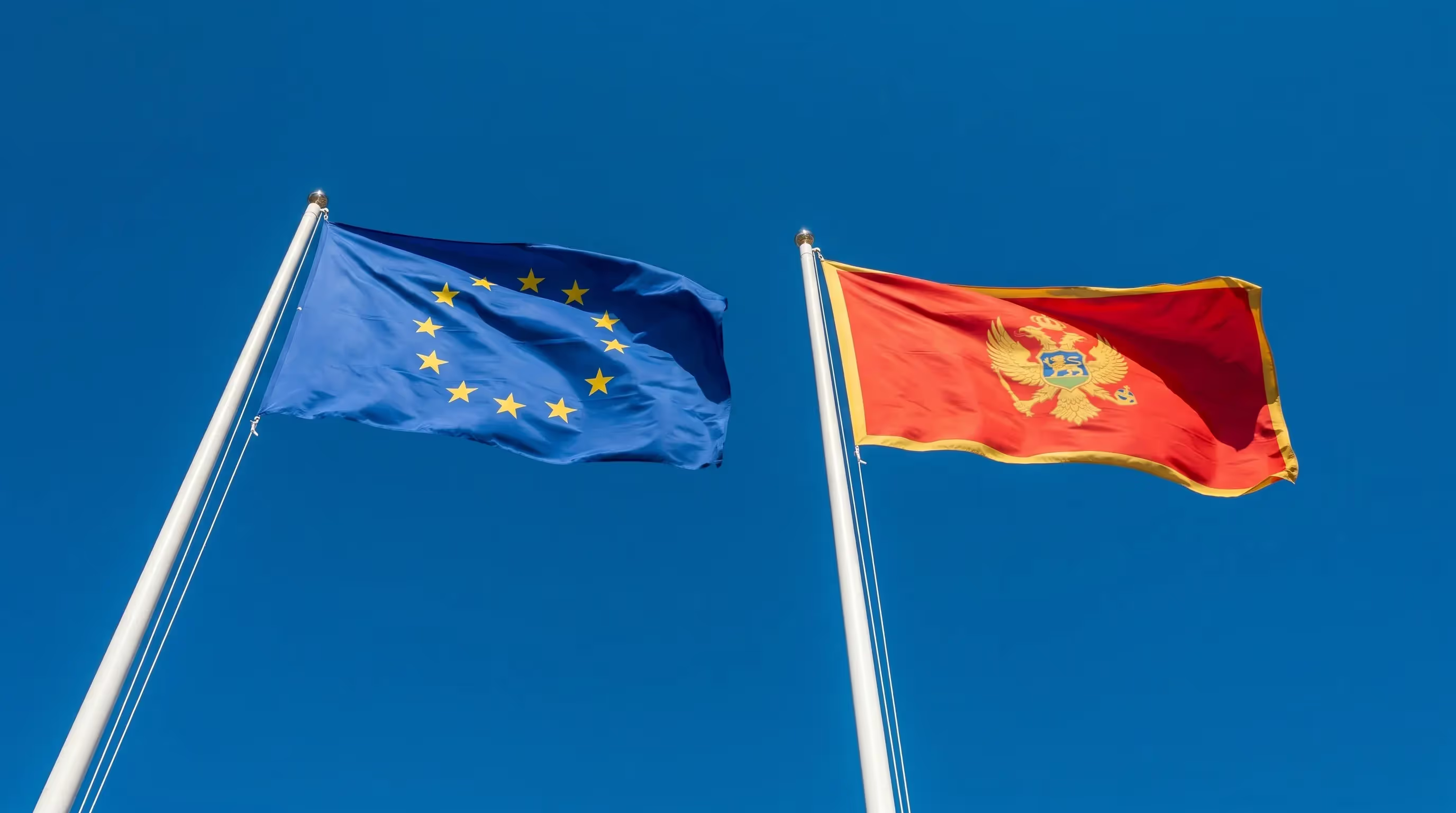
How Montenegro Now?
.avif)
Key Takeaways
- The EU–Western Balkans Summit in Tivat produced substantive outcomes: European leaders explicitly confirmed Montenegro's 2028 accession target as within reach and outlined a new framework for gradual integration before formal membership
- France and Germany jointly proposed a framework allowing candidate countries to access elements of the EU single market before accession, signalling that integration may increasingly precede membership
- European Commission President von der Leyen, Chancellor Merz and Council President Costa each made specific, attributable statements at Tivat that go beyond the usual diplomatic caution around enlargement
- Emmanuel Macron's presence marked the first official visit by a French president to Montenegro, signalling a changed French position that has historically constrained the enlargement process
- Practical integration is already underway through SEPA, Growth Plan investment and the approaching extension of the EU roaming framework, meaning the benefits of closer European alignment are arriving before formal membership
For two days this week, Tivat became an unlikely centre of European politics.
Presidents, prime ministers and senior EU officials gathered on Montenegro's Adriatic coast for the EU–Western Balkans Summit. Gatherings of this scale usually take place in Brussels or national capitals, not in a town of 14,000 people on the Bay of Kotor.
The symbolism was obvious, but the substance mattered more.
The EU–Western Balkans summit has convened regularly since 2018. For much of that period it followed a familiar pattern: communiqués reaffirming existing commitments, warm words about the importance of enlargement, and a return to the slow procedural grind that has defined Western Balkan accession politics for the better part of a decade. The Tivat edition was attended by leaders whose presence alone signalled a different register. Emmanuel Macron, making the first official visit by a French president to Montenegro, arrived the day before the summit. European Commission President Ursula von der Leyen, European Council President António Costa, German Chancellor Friedrich Merz, European Parliament President Roberta Metsola, and the heads of government of Italy, Spain and Denmark were among the forty-two delegations gathered on the waterfront.
That concentration of political weight in a Montenegrin coastal town was itself a statement. It was accompanied by a substantive proposal that marks a genuine shift in how Europe is approaching accession.
A New Framework: Gradual Integration
The most consequential development from Tivat was the emergence of gradual integration as a formally articulated EU policy approach, advanced jointly by France and Germany in a non-paper circulated ahead of the summit.
The proposal would allow candidate countries to participate in elements of the EU single market and EU programmes before formal accession is complete. Rather than treating membership as a single event, the framework envisages a rolling process through which candidate countries receive practical benefits as reforms are delivered. Deeper single-market participation, expanded access to EU programmes and possible associate-style arrangements would take effect progressively.
The approach reflects a broader shift in European thinking. The experience of previous enlargements, combined with the geopolitical consequences of Russia's invasion of Ukraine, has encouraged EU leaders to seek a model that rewards reform more quickly while reducing the long periods of uncertainty that have characterised Western Balkan accession. Candidate countries gain earlier access to practical benefits, while the EU retains leverage through a gradual, benchmark-driven process.
For Montenegro, this changes the nature of the question that serious buyers and investors have been asking. The previous framing placed EU membership at some point in the future and asked when. The gradual integration framework introduces something more useful for decision-making: the recognition that integration is already beginning, and that its practical effects do not need to wait for a ceremony in Brussels.
.avif)
German Chancellor Friedrich Merz put the political intent plainly after the summit closed:
"The clear message of today is, and will remain: We want you. And we want this region, and the states within it, to become members of the European Union soon."
European Commission President Ursula von der Leyen described the need to make "the enlargement process faster and more credible," and at the closing press conference confirmed what many had expected but few had heard stated so directly:
"Montenegro's accession as the 28th member state by 2028 is within reach."
European Council President António Costa, who spent the preceding week visiting all six Western Balkan capitals before concluding in Tivat, provided the historical anchor:
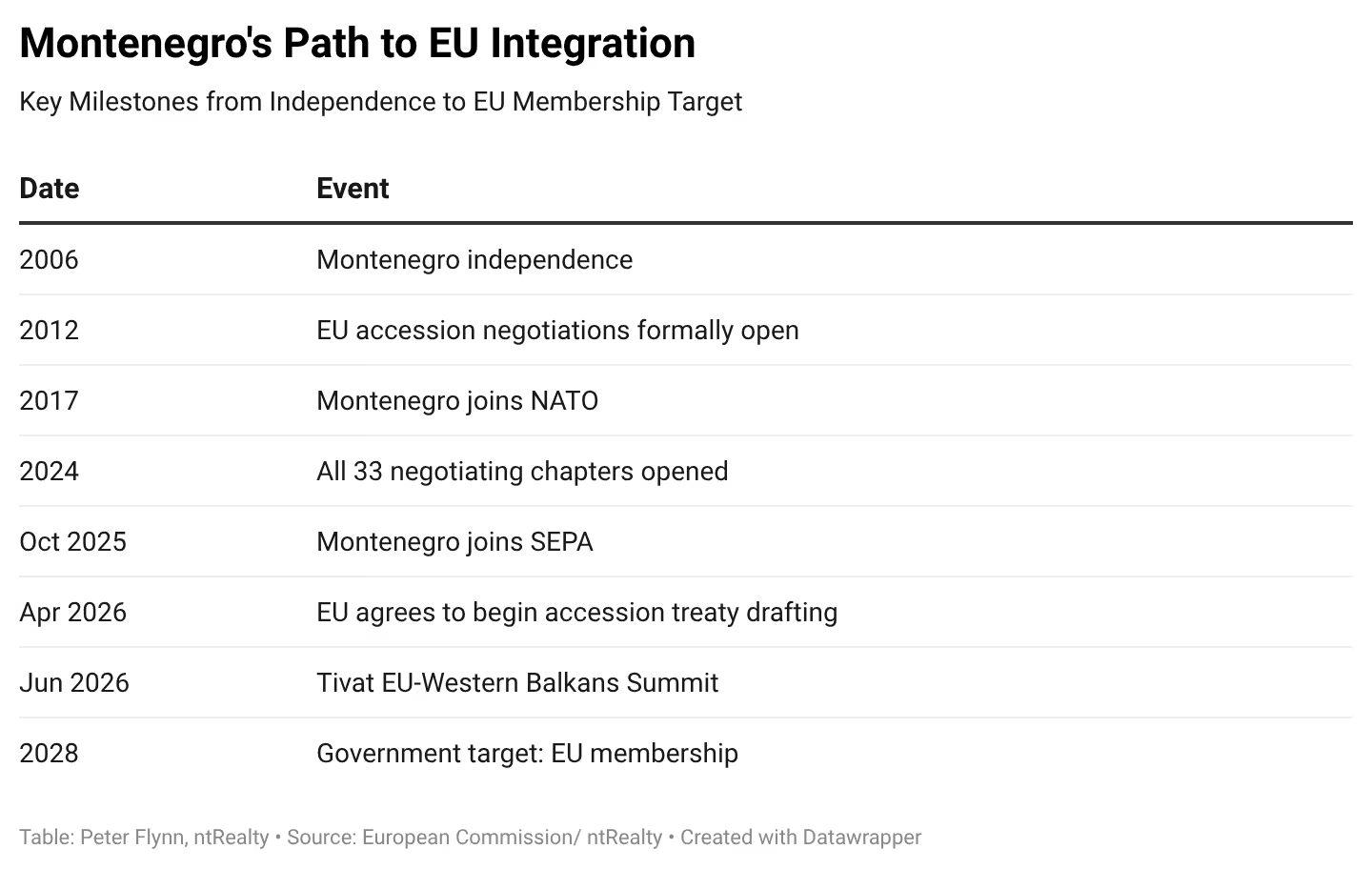
"Last month, the European Union began drafting Montenegro's accession treaty. For the first time since 2013, we are really counting down to the next enlargement."
Formal accession treaty drafting has not been initiated for any candidate country since Croatia joined in 2013. That it is now underway for Montenegro is a legal procedural step, and its significance should be read accordingly.
What Is Already Arriving
The gradual integration framework formalises a process that is already underway on several fronts, and understanding the practical detail matters more than the diplomatic language around it.
Montenegro joined SEPA in October 2025. For international property owners, business operators and residents, this means euro-denominated bank transfers to and from EU accounts now work on the same terms as transfers within the eurozone. Before SEPA membership, moving money between Montenegro and European accounts carried friction that added cost, time and administrative burden. That friction has been materially reduced. It is a small change in isolation. Over the course of owning and operating a property here, or running a business, or managing an investment, it compounds into something more significant.
At the Tivat summit, EU leaders approved the first formal step toward extending the Roam Like at Home mobile framework to Western Balkan countries. Subject to regulatory alignment, the proposal would eventually eliminate additional roaming charges between Montenegro and EU member states. For anyone dividing their time between Montenegro and elsewhere in Europe, the practical effect is obvious. The symbolic importance is that this is another European system being extended to Montenegro before membership, not after it.
The EU Growth Plan for the Western Balkans, a six billion euro facility running from 2024 to 2027, directs funding into infrastructure, green energy projects and institutional reform across the region. Montenegro has received disbursements exceeding 62 million euros since the programme began, with each payment tied to verified reform delivery. Commission officials assess progress twice yearly before releasing tranches, which means the money arriving reflects real institutional change. Prime Minister Spajić has cited three billion euros in expected private investment as a near-term consequence of the integration momentum, figures that reflect commercial decisions already being made.
Taken individually, each of these developments is incremental. Taken together, they describe a country being progressively connected into European systems in advance of formal membership.
The Macron Visit
Emmanuel Macron's arrival in Montenegro on 4 June, the day before the summit, deserves separate attention. It was the first official visit to Montenegro by a French president.
France has historically been among the more cautious major EU member states on enlargement, attentive to institutional readiness and the risk of importing instability. Macron's personal presence in Montenegro, followed by France co-signing the gradual integration proposal with Germany at the summit itself, signals a changed French position on the enlargement question. That change matters for Montenegro's trajectory because French caution has historically been one of the constraints on Western Balkan accession momentum. Its absence from Tivat is as significant as the statements that were made.
What Has Not Changed
The summit did not alter Montenegro's reform requirements. The chapters covering judiciary and fundamental rights remain the most demanding in the entire process, assessed against real benchmarks by Commission officials rather than against diplomatic impressions. The 2028 timeline has now been described as within reach by the Commission President herself. Whether it proves achievable will depend on reform delivery, not on the political atmospherics of a good summit week.
Montenegro's structural challenges are also unchanged. Bureaucracy remains inconsistent. Administrative processes can be slower than foreign buyers expect. Banking is more cumbersome than many international clients would prefer. Title complexity exists in certain market segments. A productive summit does not override any of that, and anyone presenting Montenegro as a fully frictionless market is unlikely to be providing useful advice.
What changes after Tivat is the institutional weight behind the direction of travel, and the explicitness with which European leaders have now committed themselves to the outcome.
What This Means for the Market
.avif)
Property markets rarely wait for treaties to be signed. Confidence, connectivity and institutional alignment tend to influence buyer behaviour years before formal accession occurs. Most international buyers will never read a European Commission progress report, but they notice when moving money becomes simpler, when direct flights increase, when a country appears more embedded in familiar European systems and when the political leaders of major economies are photographed on its waterfront.
For second-home buyers, the signals from Tivat reduce the perceived risk around Montenegro's long-term institutional trajectory. That does not automatically translate into price movement, but it affects the confidence with which buyers commit to a market they may have been watching.
For investors with a longer horizon, the combination of treaty drafting, the gradual integration framework, Growth Plan investment and explicit Commission endorsement of 2028 represents a materially different risk profile from a year ago. Not risk-free, but no longer the same risk profile investors were looking at a year ago.
For internationally mobile buyers and relocation candidates, SEPA already delivers practical benefit today, and the approaching extension of roaming coverage will reduce further friction in ways that have immediate effect on daily life here.
The honest qualification applies throughout. This is not a uniformly rising market. Well-located, legally clean stock in established locations benefits more than speculative land or poorly documented properties. Infrastructure confidence is not a substitute for due diligence. The attorney and the notary still matter.
The Question Has Changed
.avif)
Montenegro is not yet an EU member. The reforms are not complete. The challenges have not disappeared. No serious observer of this market would present it otherwise.
But what the events in Tivat made clear is that Europe is increasingly thinking less about whether Montenegro joins, and more about how that process unfolds and what it delivers along the way. The previous article in this series examined why Montenegro deserved attention at this particular moment. The Tivat summit offers a different vantage point. Integration is no longer purely a destination on a distant timeline. It is becoming a process with practical effects that are already visible, in payments systems and reform programmes and airline routes and the specific, committed statements of named European leaders.
Markets have historically responded to these kinds of signals long before the final ceremony takes place. That does not make the outcome inevitable. It does make it more legible than it has been for a long time. For buyers, investors and those considering a life here, that clarity may matter more than the timeline itself.
Montenegro's accession story is developing faster than at any point in the past decade. I will continue to follow it as events unfold.
Frequently Asked Questions
What did the Tivat EU summit actually decide about Montenegro?
EU leaders confirmed Montenegro's 2028 accession target is within reach, endorsed gradual integration as a new policy framework, and confirmed that Montenegro's accession treaty drafting is underway — the first such process since Croatia in 2013.
What is EU gradual integration and how does it affect Montenegro?
Gradual integration is a framework proposed by France and Germany allowing candidate countries to access elements of the EU single market before formal accession is complete. For Montenegro, benefits such as SEPA membership, roaming integration and Growth Plan funding are already arriving before the formal membership date.
What did von der Leyen say about Montenegro at the Tivat summit?
European Commission President Ursula von der Leyen stated that Montenegro's accession as the 28th EU member state by 2028 is within reach, and called for the enlargement process to be made faster and more credible.
Why was Macron's visit to Montenegro significant?
Emmanuel Macron's visit on 4 June 2026 was the first official visit by a French president to Montenegro. France has historically been among the more cautious EU member states on enlargement. Macron's presence, followed by France co-signing the gradual integration proposal with Germany, signals a changed French position that has previously constrained Western Balkan accession momentum.
Does the Tivat summit mean Montenegro property prices will rise?
The summit does not automatically translate into price movement. It changes the institutional context in which buyers make decisions. Well-located, legally clean stock in established locations is better positioned to benefit from improved confidence. Due diligence remains essential.
Sources and References
Summit statements by European Commission President Ursula von der Leyen, European Council President António Costa and German Chancellor Friedrich Merz are drawn from official EU Council press conference transcripts and wire reporting by the Associated Press, Al Jazeera, Reuters and France24 on 5 June 2026. Growth Plan disbursement figures are from the European Commission. Summit photography is reproduced from the EU Council Newsroom (consilium.europa.eu) in accordance with EU Council copyright policy. The Datawrapper infographic was created by NT Realty using data from the European Commission and publicly verified sources.
Related Reading
About the Author
Peter Flynn moved to Montenegro in 2005 and began working in the country's property market as a private speculator. He established New Territory DOO in 2006 to formalise his operations after the country gained independence. With two decades of experience guiding international buyers through Montenegro's property market and residency processes, he specialises in the Tivat and Bay of Kotor area. Working alongside business partner Maša Flynn, NT Realty (which takes its name from the New Territory holding company) has helped hundreds of buyers from the US, UK, Australia, and beyond navigate Montenegro's evolving legal and regulatory landscape. Peter maintains close working relationships with local lawyers, notaries, and government officials, providing clients with current, practical guidance rooted in on-the-ground experience.
In this article
Get luxury real estate updates directly in your inbox.
Are you interested in buying a home? Look no further than working with our real estate experts.

.avif)
.avif)