
New Routes, New Buyers: What Montenegro’s Aviation Expansion Means for Bay of Kotor Property
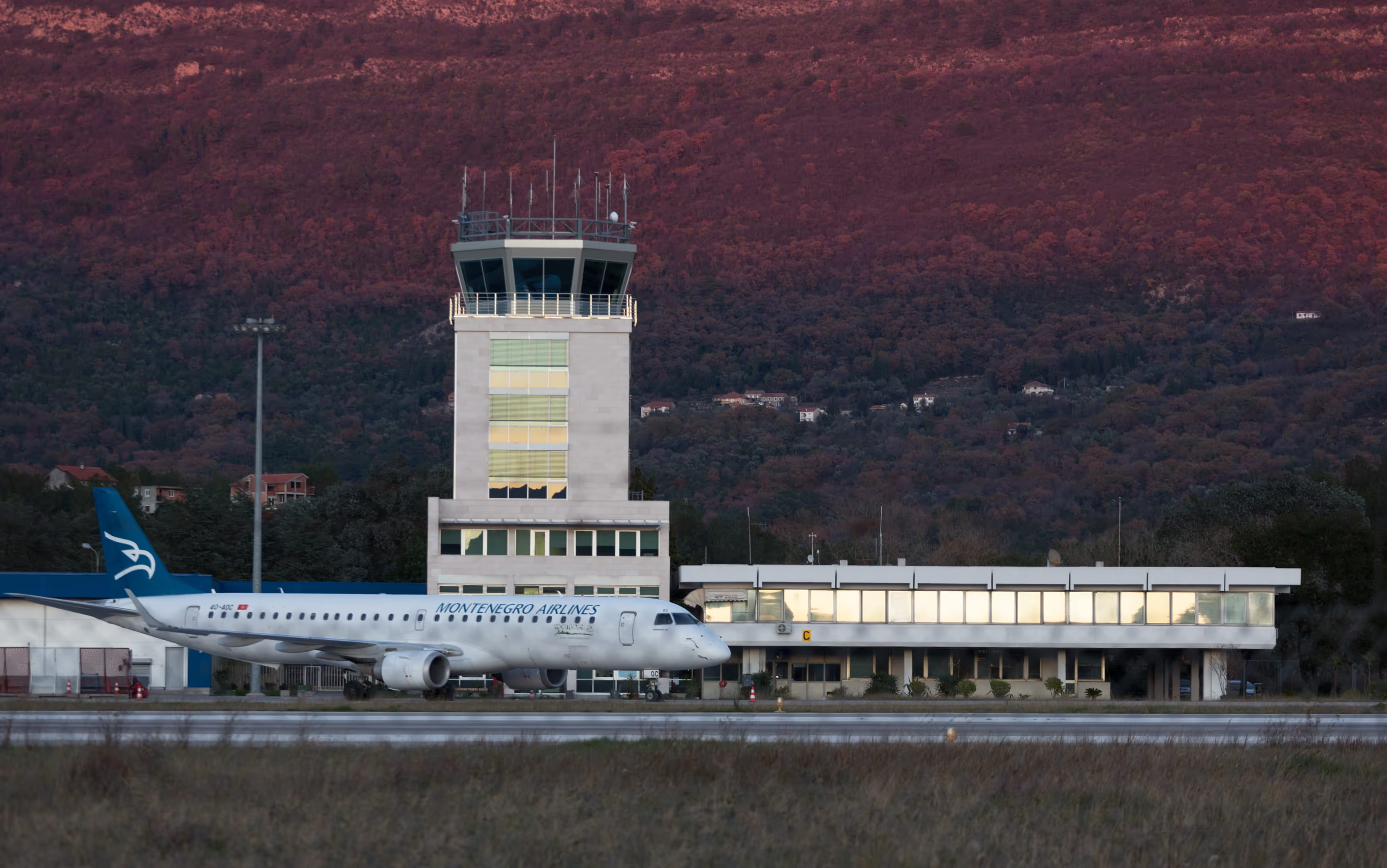
A structural shift in how Europe reaches Montenegro's coast is already reshaping the property market — and the data tells a clearer story than most analysis acknowledges.
For years, international buyers approaching Montenegro's coast faced a familiar problem. The access was real — but fragile. Tivat Airport delivered them directly into the Bay, but its schedule was full in summer and thin in winter. Podgorica sat in the background as a secondary option. Dubrovnik served as the reliable backup.
That picture is now changing — and changing fast. Two things are happening at once, from two different directions.
Key Takeaways
- Wizz Air's Podgorica base, launching March 2026, adds capacity equivalent to roughly one million additional seats annually and makes it Montenegro's number one carrier — transforming Podgorica into a genuine year-round hub for the first time
- British Airways will operate the first ever direct full-service flight from London Heathrow to Tivat from May 2026 — a signal of market maturation, not just another route addition
- Coastal property prices rose around 20% nationally in 2024 according to MONSTAT, while new supply faces constraints from multiple directions — a dynamic worth understanding before entering the market
- Improved connectivity affects not just buying but selling — wider access expands the future resale audience and supports long-term liquidity
Why this matters for investors
Accessibility is one of the most reliable drivers of second-home market development. The Bay of Kotor is now being reached from more European cities, on better carriers, more affordably than at any point in its history. That changes who can visit, who can buy, and — eventually — who can sell to.

The Podgorica Transformation
On 14 October 2025, Wizz Air announced it would open its 36th global base at Podgorica Airport from March 2026. Two Airbus A321neo aircraft will be stationed there permanently. Fourteen new routes launch alongside the base — Paris, Barcelona, Hamburg, Rome, Cologne, Malmö, Gdańsk, Wrocław, and more. Combined with existing services, Wizz Air will fly 23 routes across 12 countries from Podgorica by summer 2026, adding capacity equivalent to roughly one million additional seats annually. With this expansion, Wizz Air becomes Montenegro's number one carrier overall — a position confirmed in the airline's own announcement and by Airports of Montenegro.
In a country that received around 2.6 million recorded tourist arrivals in all of 2024, according to MONSTAT, that is a structural shift — not an incremental one.
The difference between a base and a route announcement matters. Stationed aircraft mean more daily rotations, earlier departures, more competitive fares, and the ability to adapt across seasons. Podgorica stops being a secondary option. It becomes a genuine year-round hub.
This matters directly for the Bay of Kotor — even for buyers focused on Tivat, Kotor, or Luštica. Podgorica is about 75 minutes from the Bay. For owners visiting in winter, contractors travelling between projects, or buyers making relocation trips, year-round access from Podgorica extends the coast's practical calendar. Podgorica isn't competing with the coast. It has become infrastructure for it.
Tivat Has Moved Up-Market
While the volume story belongs to Podgorica, the shift at Tivat may matter more for premium coastal real estate.
British Airways will launch the first ever direct flight between London Heathrow and Montenegro on 14 May 2026, operating three times a week through to late September. This is not a routine addition. It is the UK flag carrier entering Montenegro on its main hub — Heathrow Terminal 3. And it is the first Montenegro route on which UK buyers can book using Avios or OneWorld miles.
That distinction is worth unpacking. Heathrow travellers are a different demographic from those flying charter or budget carriers from Gatwick or Stansted. They tend to spend more per trip. Many hold loyalty status with BA and its partners. Club Europe — BA's short-haul business class — will be available on the route, bringing business-class access to Montenegro from the UK for the first time. The route doesn't just add seats. It adds a buyer profile.
British Airways aside, the picture at Tivat in 2026 is striking. Norwegian and SAS fly from Scandinavian capitals. Transavia France connects Paris Orly. TUI Netherlands serves Amsterdam. Austrian Airlines returns to Vienna. Flydubai — the Dubai-based carrier partnered with Emirates — opens a daily Tivat–Dubai service from May 2026, creating a Gulf corridor with no precedent in Montenegro's aviation history. European aviation capacity into Montenegro has expanded materially ahead of the 2026 summer season, with both low-cost and full-service carriers increasing their presence. As of early 2026, more than two dozen airlines fly Tivat to dozens of destinations worldwide, including four separate London connections.
When full-service and quality carriers enter a market, they carry a signal beyond their seat counts. They tell high-net-worth travellers that a destination is worth their time. They tell second-home buyers that resale will be viable. They put the Bay of Kotor on a different mental map.
A New Purchase Pathway: The Weekend-Break Effect
Lower fares from newly connected cities — Warsaw, Hamburg, Malmö, Barcelona, Paris — don't just bring tourists. They create a repeat-visit cycle that second-home markets run on.
The pattern is well established. An affordable short break leads to familiarity. Familiarity leads to return visits. Return visits lead to rental trials. Rental trials lead to purchase. This is how the Algarve built its UK buyer base. It's how Croatia's coast accumulated its German and Austrian owners. Montenegro is now entering that cycle from a far larger number of European cities than it could reach before.
The buyers who will purchase in the Bay of Kotor in 2028 or 2029 are starting to visit in 2026 — in many cases for the first time. That pipeline won't show up in transaction data yet. It will.
.jpeg)
Tourism Growth: Reading the Data Correctly
Montenegro's headline tourism figures need some context. The apparent softness in 2024 and early 2025 partly reflects a demographic shift rather than a genuine demand drop. A significant number of Russian and Ukrainian citizens who had relocated to Montenegro after 2022 were counted within tourism statistics. As they have left, the figures have compressed — but underlying demand from leisure and lifestyle visitors has continued to grow.
When viewed alongside longer-term trends, the picture remains positive. According to Montenegro's Ministry of Tourism, compared to the pre-pandemic record year of 2019, visitor numbers in the first seven months of 2025 were around 14% higher, with overnight stays up roughly 16%. The composition of visitors is also shifting. Germany, the UK, and France were the three largest European origin markets in October 2025, according to MONSTAT — exactly the countries now receiving the most significant new direct routes. Markets including China, Israel, and Azerbaijan have grown sharply from a low base, broadening the visitor geography further.
Airlines follow demonstrated demand before they create it. The route expansion and the visitor data are telling the same story.
The Property Market Is Already Responding
The market has not waited for confirmation.
Nationally, property prices rose around 20% in 2024, according to MONSTAT — substantially higher than most EU markets over the same period. In prime coastal micro-markets the move has been sharper, with some locations recording strong double-digit gains over two years. By Q3 2025, average coastal residential prices had reached around €2,400–2,500 per square metre nationally. In premium Tivat — particularly waterfront and marina-adjacent product — prices reach well above that level.
These are not uniform figures. Northern regions and secondary towns perform quite differently. Transaction volumes in Montenegro remain thin relative to larger European markets, which means pricing signals can be volatile and should not be overstated.
What gives the demand story additional weight is what is happening on the supply side. New permit numbers fell sharply in early 2025 following a regulatory transition before recovering in Q3 — the disruption appears procedural rather than structural, but the pipeline delay means new coastal stock remains limited in the near term. In Kotor's core zone, the Ministry of Heritage has effectively paused planning applications while a protection study is completed, with no published end date. And a legalisation law that came into force in August 2025 has temporarily frozen the sale of unlegalised properties, removing a meaningful slice of the coastal resale market from circulation until owners complete the process. We cover the full picture in The Temporary Supply Shock That Could Make Montenegro's Coastal Market Even Stronger.
None of this makes price appreciation inevitable. But it describes a market where new supply is delayed, resale stock is partially constrained, and development in the most sought-after locations is on hold — at precisely the moment when improved connectivity is expanding the pool of potential buyers. Connectivity expansion does not guarantee price appreciation, but historically it alters the probability distribution of demand.
The Liquidity Argument
Connectivity shapes not just buying — but selling. This point rarely gets enough attention.
A property purchased in the Bay of Kotor today will eventually be sold to a buyer who needs to reach Montenegro conveniently. The wider the pool of people who can do that — by nationality, origin city, and ease of travel — the faster the likely time-to-sale and the more competitive the resale environment.
Every new direct route that survives its first season expands the future resale audience. British Airways flying Heathrow–Tivat doesn't just bring buyers in 2026. It widens the population of UK-based buyers who might purchase — or purchase again — in future years. The Flydubai Gulf corridor does the same for Middle Eastern buyers. Liquidity follows accessibility. This is as true in property as it is anywhere else.
Podgorica in Winter: More Than Tourism
One benefit that rarely appears in investment analysis is the operational utility of year-round Podgorica access — independent of tourist numbers.
Owning coastal property in Montenegro involves real ongoing logistics: contractor visits, renovation work, property management, rental changeovers, owner trips outside summer. Tivat's thin winter schedule has historically made all of this harder than it should be.
With Wizz Air operating a year-round base from Podgorica across 23 routes by summer 2026, those constraints ease considerably. An owner flying from Paris or Hamburg to check on a property in February no longer needs an indirect routing or a drive from Dubrovnik. This won't show up in tourism statistics. It shows up in the quality of ownership — and in the confidence with which serious buyers commit to properties they intend to use year-round.
The EU Factor
Montenegro is the most advanced EU candidate country in the Western Balkans. All 33 negotiating chapters are open. The commonly cited accession window is the late 2020s — though the process involves variables outside Montenegro's full control, and no timeline should be treated as fixed.
What is observable is how markets tend to behave in anticipation. Croatia's property values rose sharply in the years before its 2013 accession — a pattern we examine in detail in Reading Tivat's Property Map: Lessons from Croatia's EU Accession. Each milestone in Montenegro's own accession process reduces perceived political risk for foreign buyers and adds a layer of confidence to long-term holding decisions.
Aviation expansion and EU alignment also tend to reinforce each other. Better connectivity brings more international engagement. More international engagement supports infrastructure investment. Better infrastructure strengthens the case for accession. The relationship is reinforcing — though not automatic, and not without risk.
For non-EU buyers considering Montenegro, understanding the evolving residency framework is an important part of the picture alongside connectivity improvements.
The Structural Picture
The Bay of Kotor is now being reached from two directions at once.
Through Tivat: buyers from premium origin markets, on full-service carriers, including — for the first time — London Heathrow and the Gulf. Through Podgorica: a far larger pool of European travellers on new direct routes at accessible prices, beginning the familiarity cycle that drives second-home markets.
Dubrovnik remains a useful option. But its role as a necessity has gone. It has moved from workaround to comfort blanket.
The convergence of a growing international buyer pool, constrained coastal supply, EU accession momentum, and a step-change in air access creates a compounding environment. These forces don't simply add to each other — they reinforce each other, with each one making the others more effective. And this isn't only about where buyers come from. It's about how they arrive at a decision — increasingly, through a process of repeated visits, growing familiarity, and a recalibration of where they want to be. We explored that shift in The Repricing of Place, and Montenegro sits squarely within it.
Montenegro also faces real constraints: infrastructure pressures, a thin transaction market, regulatory uncertainty, and a seasonality that connectivity alone will not fully solve.
For anyone tracking the Bay of Kotor as an investment market, the aviation story is not background noise. Right now, it is the infrastructure of demand itself.

About the Author
Peter Flynn moved to Montenegro in 2005 and began working in the country's property market as a private speculator. He established New Territory DOO in 2006 to formalise his operations after the country gained independence. With two decades of experience guiding international buyers through Montenegro's property market and residency processes, he specialises in the Tivat and Bay of Kotor area. Working alongside business partner Maša Flynn, NT Realty (which takes its name from the New Territory holding company) has helped hundreds of buyers from the US, UK, Australia, and beyond navigate Montenegro's evolving legal and regulatory landscape. Peter maintains close working relationships with local lawyers, notaries, and government officials, providing clients with current, practical guidance rooted in on-the-ground experience.
In this article
Get luxury real estate updates directly in your inbox.
Are you interested in buying a home? Look no further than working with our real estate experts.

.avif)
.avif)
.avif)