

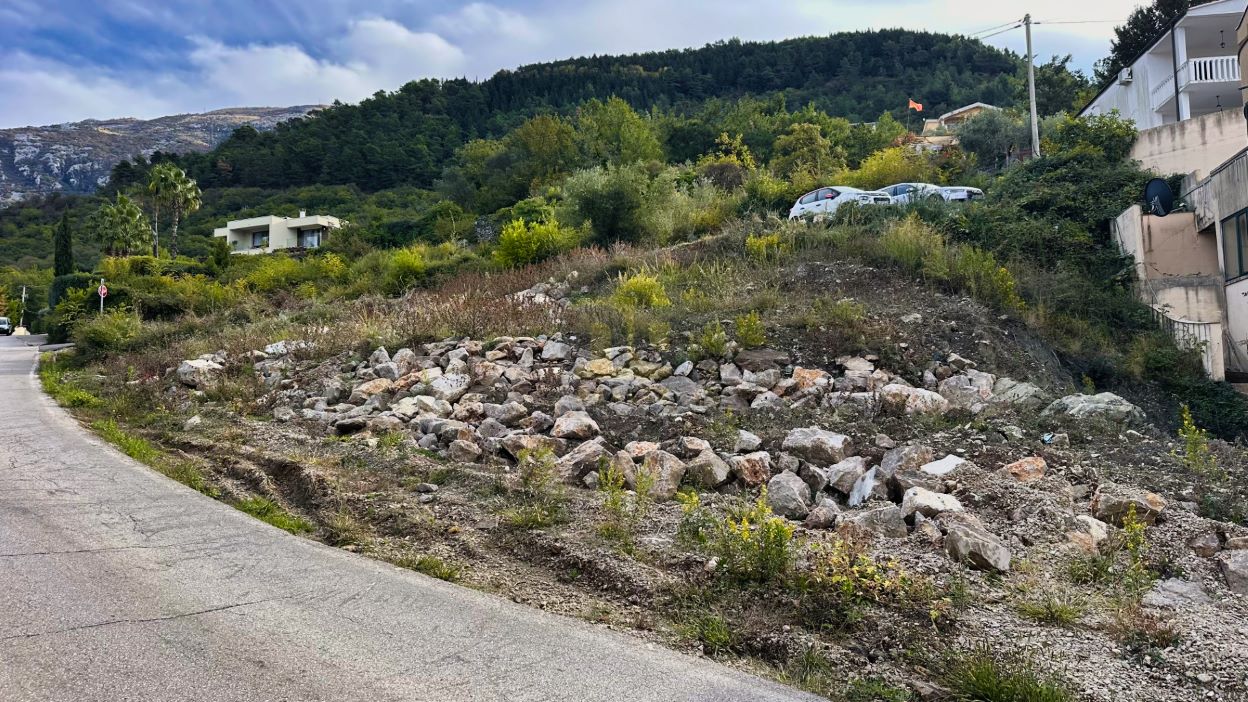
Building plot with Sea Views in Pržice, Kotor for Sale
250,000

Peter Flynn
Features
Explore in 3D
Guided Video Tour
In Brief
A 667 m² urban parcel in Pržice, on the hillside between Kotor and Tivat. It faces southwest over Tivat Bay and comes with an approved design and a building permit for a residential building of eight apartments, with a pool and a twelve-space underground garage. The communal fees required before construction can begin have already been paid and are included in the price. A buyer can build the approved project as it stands, or start again with their own design under the same planning parameters.
Price: €250,000 (communal fees paid and included)
Description
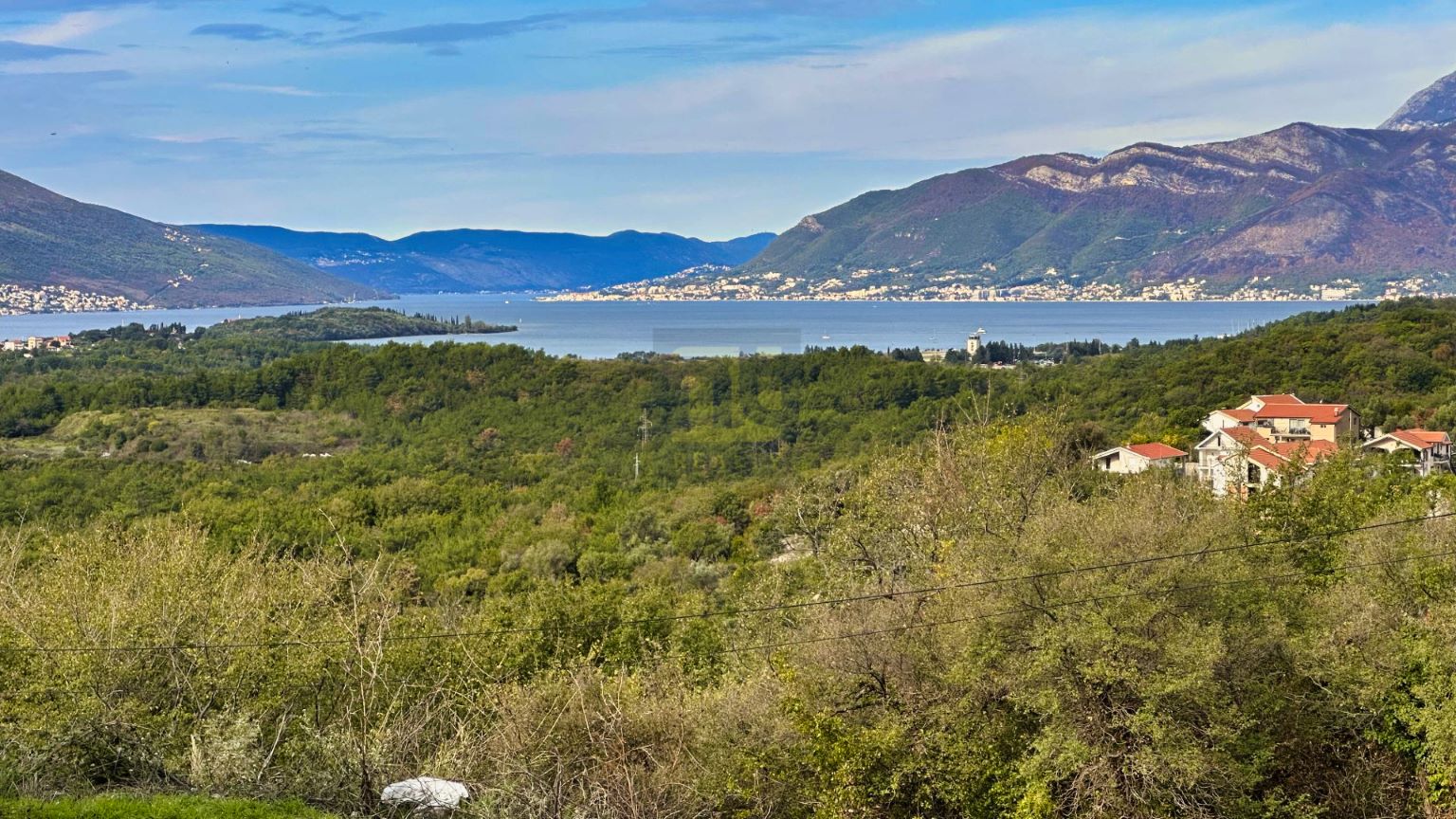
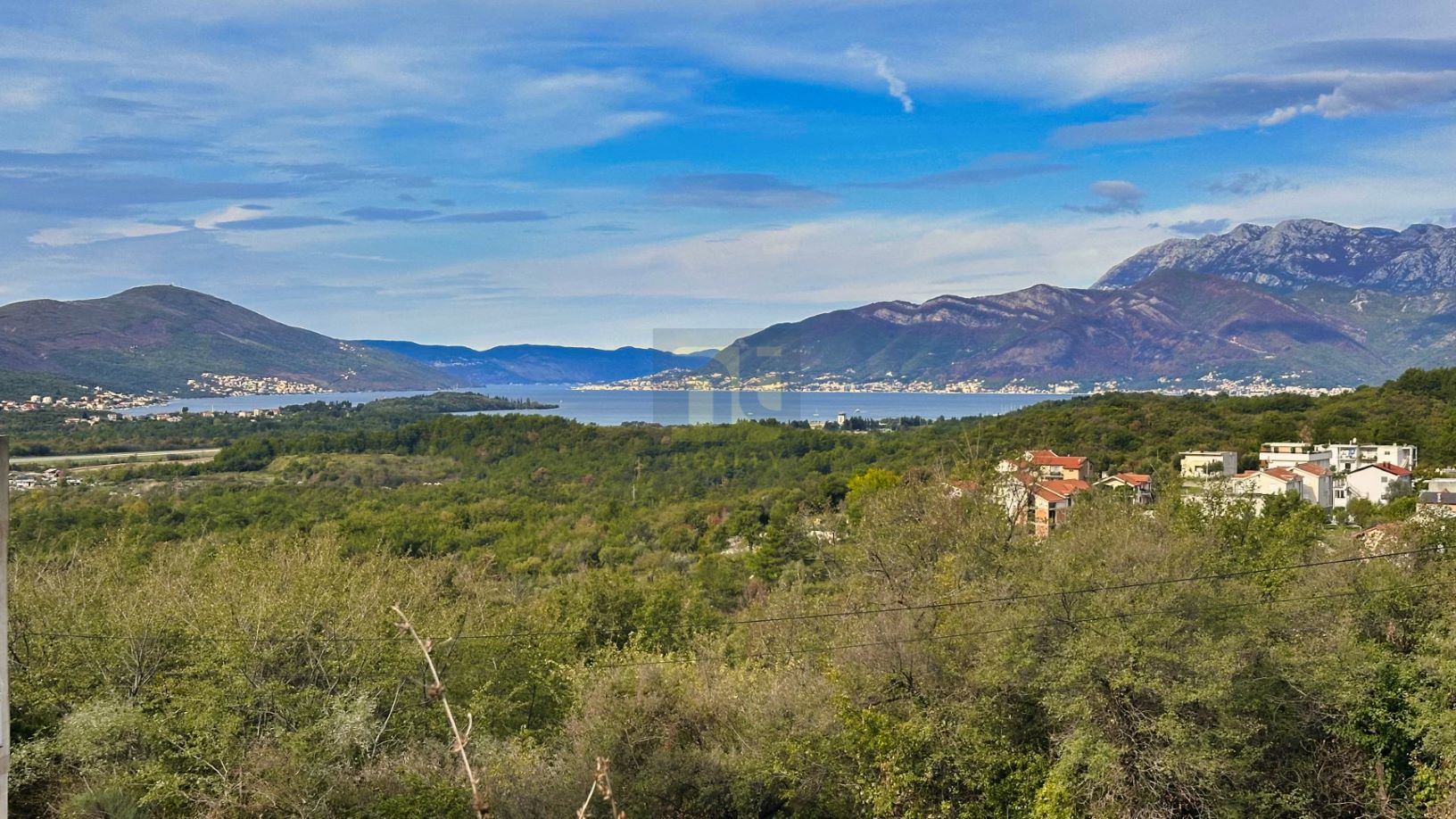
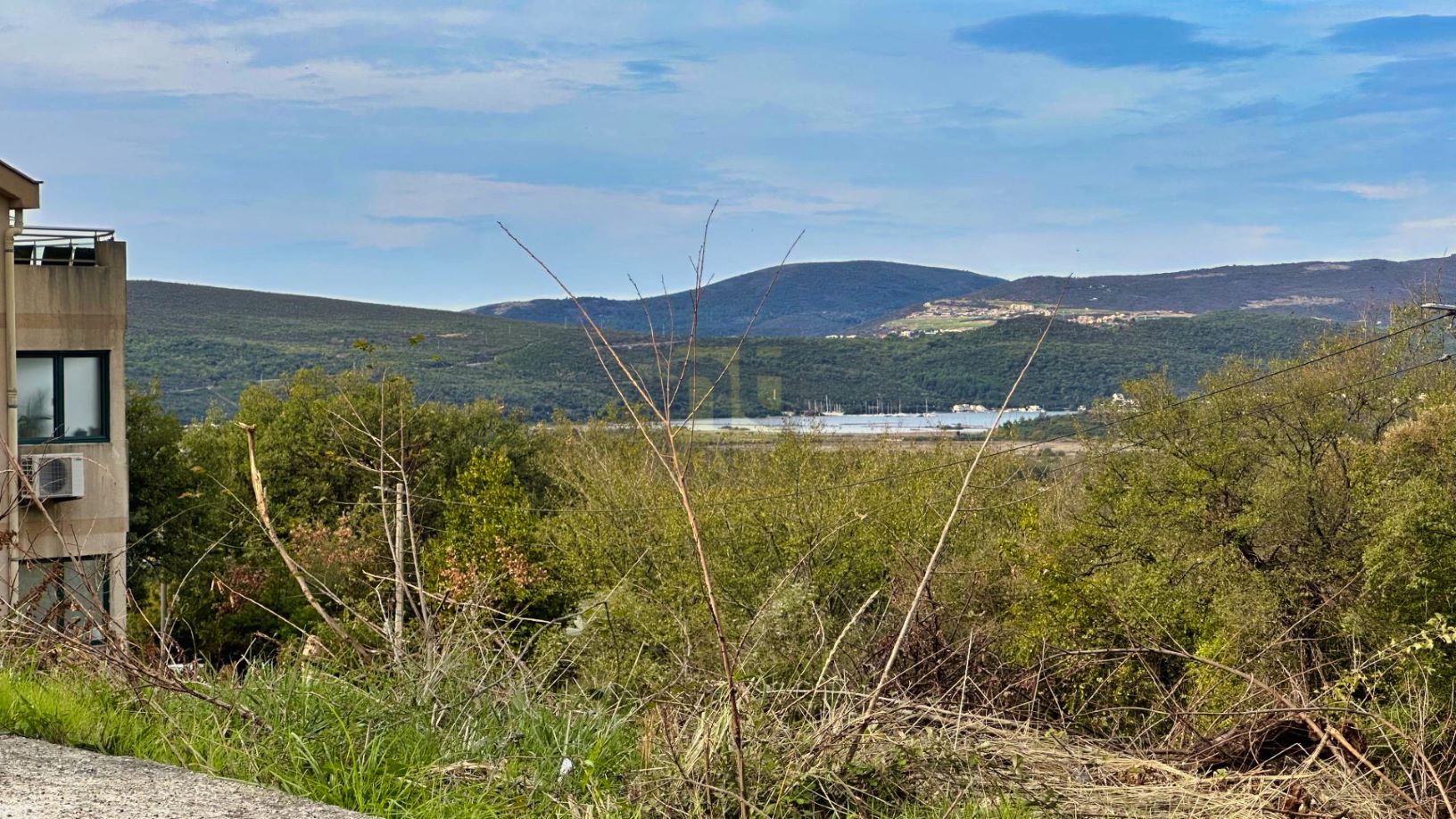
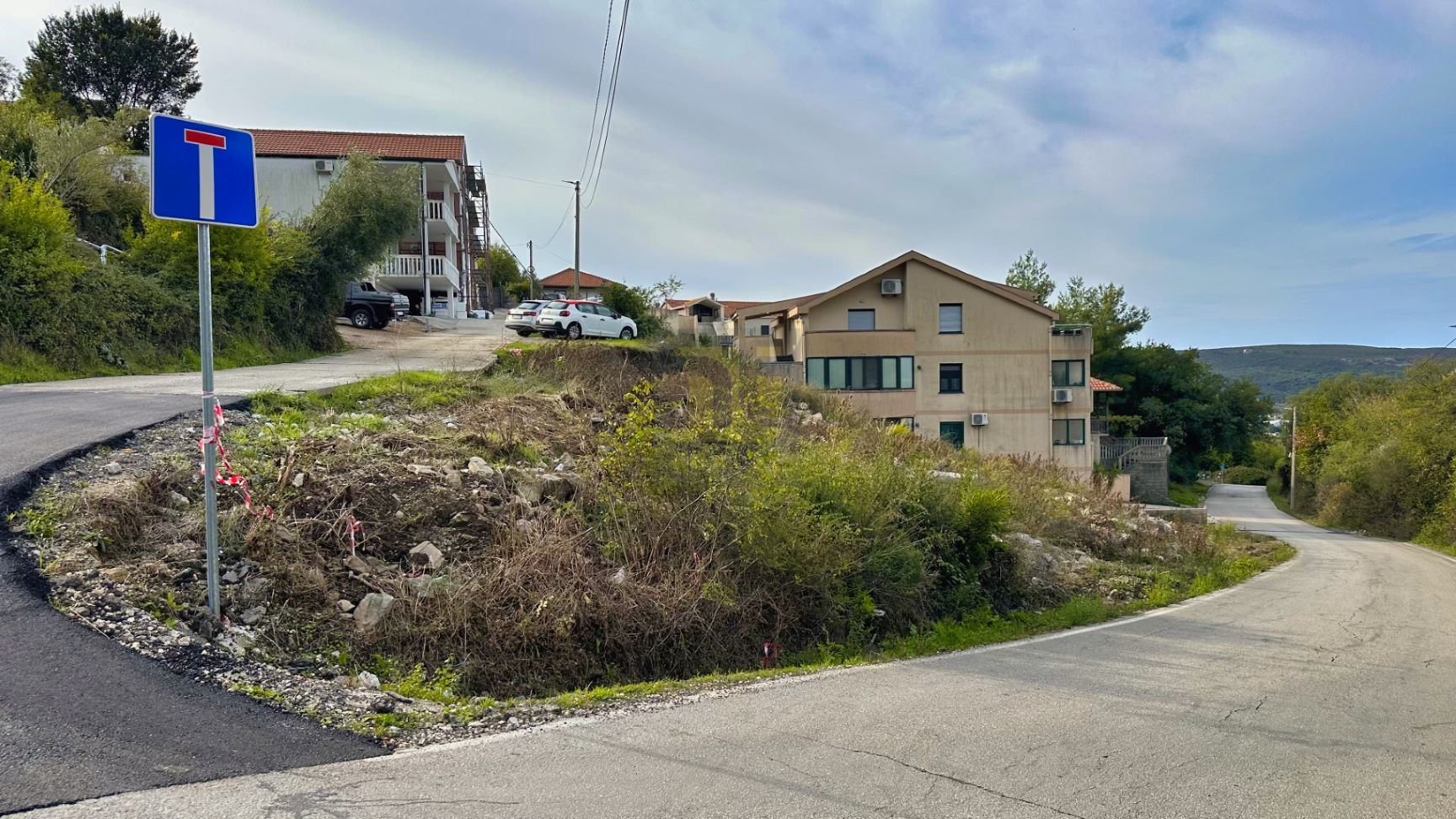
The plot sits in Pržice, in the cadastral municipality of Dub, within the Municipality of Kotor. It is a quiet residential pocket set back from through traffic, yet only a few minutes from the main roads linking Kotor, Tivat and the coast to Budva. Kotor Old Town is about 3.7 km by road, Tivat Airport about 4.8 km and Porto Montenegro about 8.4 km, each well under a quarter of an hour by car. Facing southwest, the site looks out across Tivat Bay and gets the afternoon and evening light.
The planning conditions allow an occupancy index of 0.3 and a build index of 0.8. On a 667 m² parcel, that means a maximum footprint of about 200 m² and a maximum gross building area (BGP) of 533.6 m² above ground. The permitted height is ground floor, first floor and attic (P+1+Pk), with basement levels allowed on top of that. With a flat roof the building can rise to 11.50 m to the top of the parapet. With a pitched roof the limit is 10.00 m to the cornice and 12.00 m to the ridge.
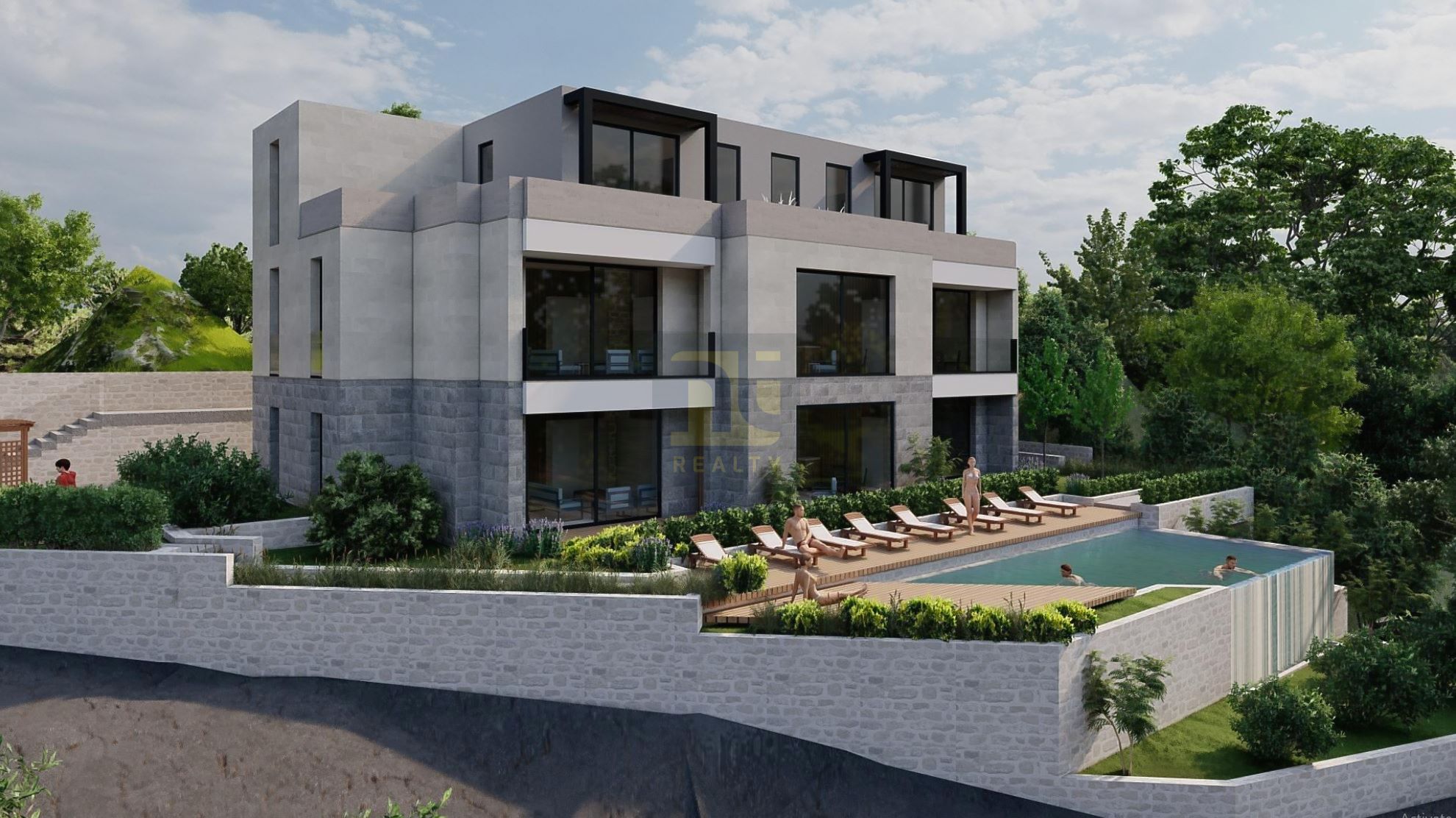
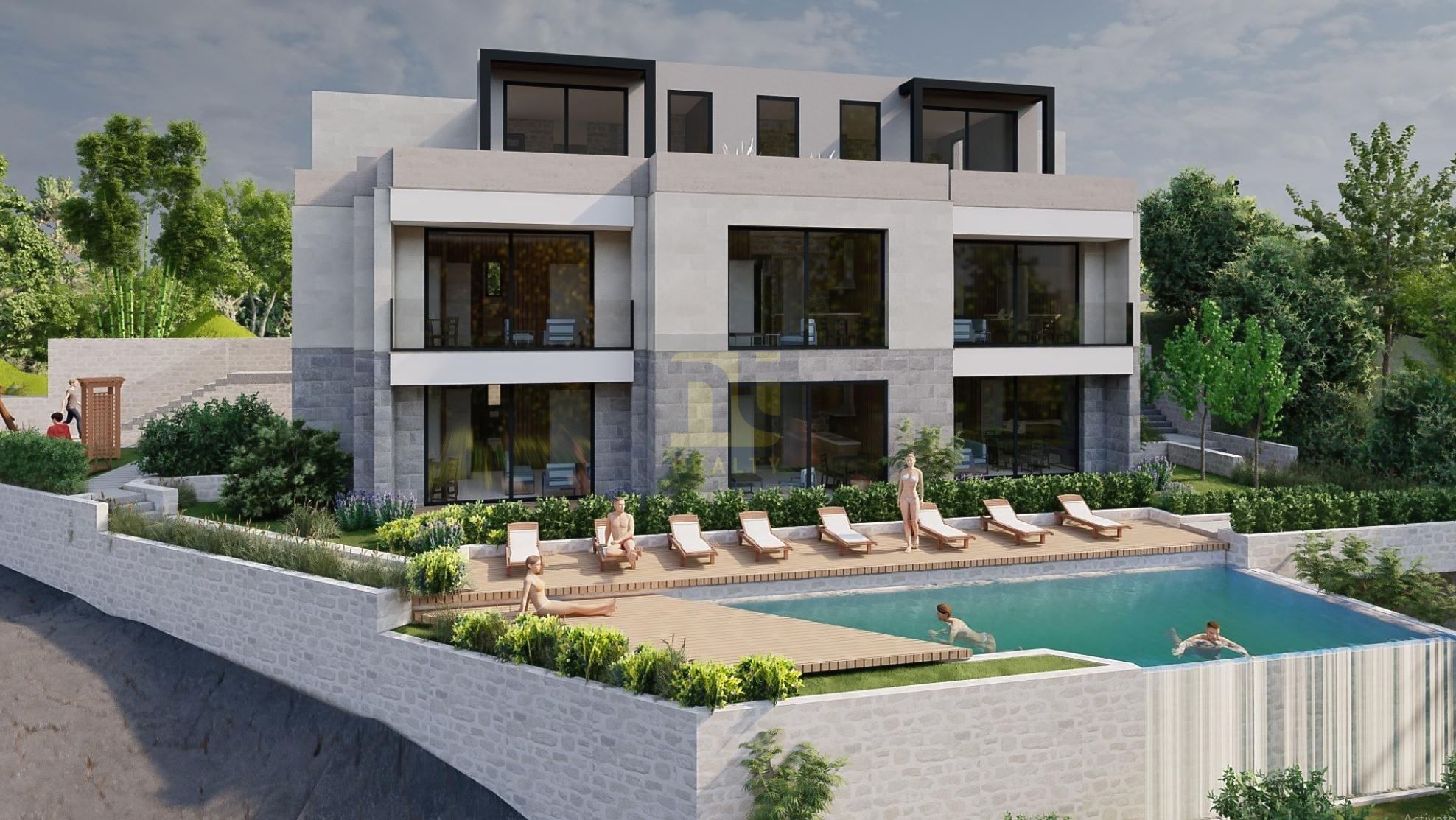
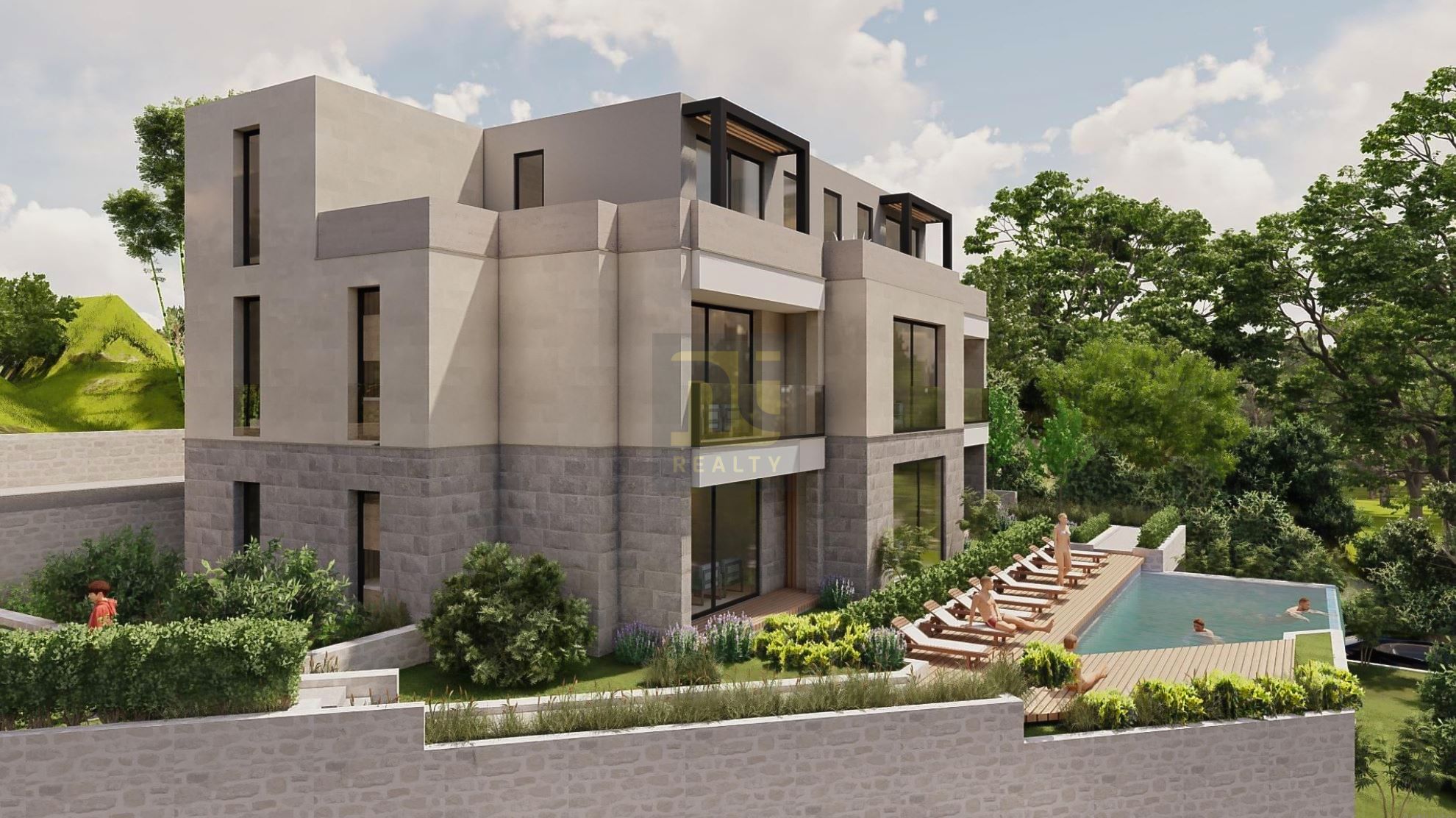
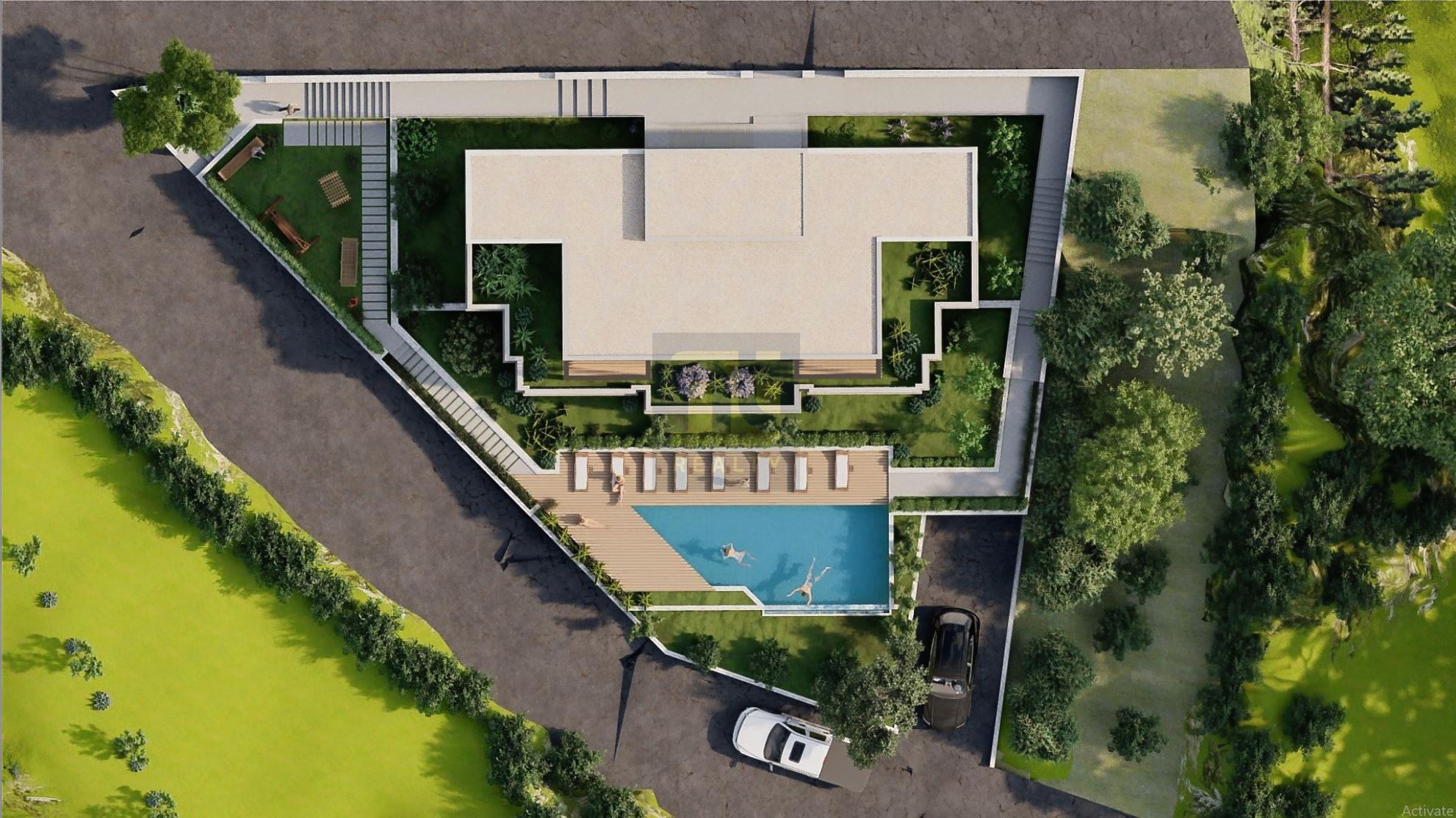
The approved design uses that capacity in full. It is a three-storey stone-clad building over a basement level, with eight apartments, a lift, landscaped terraces and an infinity pool with a timber sun deck set into the slope.
- Basement: 444.54 m² gross. Garage with 12 parking spaces, four storerooms, technical rooms, lift and stair core, and the pool structure (34 m²).
- Ground floor: 198.81 m² gross. Three apartments: two two-bedroom units of 56.73 m² and 63.97 m² and a 33.24 m² studio. The two-bedroom units have terraces and garden frontage.
- First floor: 196.23 m² gross. Three apartments: two two-bedroom units of 60.64 m² and 60.74 m² and a 26.11 m² studio.
- Recessed top floor: 138.51 m² gross. Two apartments: a 46.73 m² one-bedroom and a 60.91 m² two-bedroom, each with a pergola-covered terrace facing the bay.
The above-ground floors total 533.55 m² gross, which is the full permitted figure. They give about 409 m² of net apartment area across eight units: five two-bedroom apartments, one one-bedroom and two studios. With the basement included, the building totals about 978 m² gross.
Because the permit is in place and the communal fees are paid, the main administrative and cost hurdles before construction have already been cleared. A buyer can go ahead with the approved project and its existing permit. If a different scheme suits them better, such as fewer and larger apartments or a single private villa, they can commission a new design within the same planning conditions and obtain new approvals and a new permit.
Key Features
- 667 m² urban parcel in Pržice, Municipality of Kotor
- Southwest aspect with views over Tivat Bay
- Building permit issued on an approved design
- Communal fees paid and included in the price
- Maximum gross building area 533.6 m² (build index 0.8, occupancy 0.3)
- Permitted height P+1+Pk, with basement levels allowed
- Approved scheme: eight apartments, ~409 m² net residential area
- Underground garage for 12 cars, storerooms and lift
- Infinity pool and landscaped terraces in the approved design
- ~3.7 km to Kotor Old Town, ~4.8 km to Tivat Airport
What Sets It Apart
Most land for sale around the bay is sold with planning conditions only, which leaves the buyer to face months of design work, approvals and fee assessments before anything can be built. This plot has the approved design and the building permit in place, and the communal fees are paid, so construction can start without first going through that process. The design is also efficient. It uses the full permitted area, fits twelve parking spaces underground and puts the pool on the downhill edge of the site, facing the view.
The location works just as well. Pržice is quiet and residential, with no main road running past the plot, yet the Kotor–Tivat and coastal roads are minutes away. That puts Kotor, Tivat, the airport and Budva all within a short drive.
Buyer Lens
- Developers: A permitted, fees-paid scheme of eight apartments in the Kotor–Tivat corridor, with a unit mix weighted towards two-bedroom apartments, which are the most sought-after size for both owner-occupiers and rental investors in the area.
- Private buyers: The capacity to build a substantial private villa with guest accommodation, pool and garaging on a southwest-facing site above Tivat Bay, under a new design within the existing planning parameters.
- Investors: A short drive to Tivat Airport, Porto Montenegro and Kotor Old Town supports year-round demand for both long-term and holiday lets.
Local Amenities
All distances are by road, measured from the plot.
By Car – Kotor
- Voli supermarket, Lješevići: ~2.2 km (~4 min)
- HDL shopping centre: ~2.4 km
- Kotor Old Town: ~3.7 km (~7 min)
By Car – Tivat and the Coast
- Tivat Airport: ~4.8 km (~7 min)
- Tivat centre (Pine promenade): ~7.8 km (~14 min)
- Boka Place, Tivat: ~8.2 km (~14 min)
- Porto Montenegro: ~8.4 km (~15 min)
- Luštica Bay: ~9.6 km (~13 min)
- Budva Old Town: ~20 km (~29 min)
Schools
- Arcadia Academy (international school): ~2.2 km (~5 min)
- Primary school “Njegoš”, Škaljari: ~4 km (~10 min)
- Primary school “Njegoš”, Kotor: ~4.3 km (~10 min)
- Primary school “Narodni heroj Savo Ilić”, Dobrota: ~5.8 km (~12 min)
- Secondary education centre, Dobrota: ~5.8 km (~12 min)
- Knightsbridge Schools International, Tivat: ~8.2 km (~14 min)
- Primary school, Tivat: ~8.2 km (~13 min)
Healthcare
- Kotor General Hospital: ~4 km (~10 min)
- Kotor Health Centre (Dom zdravlja): ~5.5 km (~10 min)
- Mansa Medica, Tivat: ~7.5 km (~11 min)
- Milmedika, Tivat: ~8.3 km (~14 min)
Further Afield
- Dubrovnik Airport (Croatia): ~55 km (~1 hr 30 min, plus border crossing)
- Podgorica Airport: ~75 km (~1 hr 35 min)
Agent’s Honest Take
This is a well-prepared plot. The design, the permit and the communal fees are the slow and expensive parts of developing in Montenegro, and they are already done. Buyers should note that the approved scheme uses the full permitted gross area, so there is no extra area left to gain under the current planning conditions. The extra value comes from how the building is finished, not from building more of it. The site slopes, so the basement and pool terraces need retaining walls and excavation, and these should be budgeted from the start. The location suits buyers who drive, since Kotor, Tivat and the schools are all a short trip by car rather than on foot. In return, the plot has quiet surroundings and an open view over the bay, which are increasingly hard to find this close to both towns.
For full documentation, including the planning conditions, approved design drawings and permit, or to arrange a site visit, contact NT Realty. We are based in Tivat and work across the Bay of Kotor.
NT Realty is a boutique real estate agency based in Tivat, Montenegro. Founded by Peter Flynn, who first came to the Bay of Kotor in 2005 as a property investor and has since built businesses across real estate development, architecture, and interior design, the agency is run alongside Maša Flynn — architect and former Head of Design at Porto Montenegro, where she delivered over €60 million of projects on time and on budget. Between them they bring a depth of local market knowledge that is difficult to find elsewhere in the region.
The team specialises in properties for sale and long-term rentals across the Bay of Kotor, Tivat Bay, and the Luštica Peninsula — from Porto Montenegro and Luštica Bay to private homes throughout the wider region. Our job is to guide buyers, sellers, and tenants through the process clearly, honestly, and without unnecessary complexity.
Map
Neighbourhood Guide
Explore Kotor
Learn More about living in Kotor: Things to Do and See in Kotor
Frequently Asked Questions

After purchase and registration, you'll receive keys and take possession. Next steps include transferring utilities to your name, setting up building management payments if it's an apartment, getting home insurance, and—if you're renting it out—registering for tourist tax and obtaining any required permits. Your lawyer or agent can guide you through the administrative bits.
Rental income is taxed at 15% on gross receipts if you're renting short-term (tourist rentals), or you can opt for taxation on net income after expenses for long-term rentals. You'll also pay municipal tourist tax (€1 per night per guest in high season, €0.50 in low season) and need to register your rental with the tax authorities and tourism directorate.
Annual property tax is quite low—just 0.25% of the property's assessed value per year. The assessed value is typically well below market value, so you might pay €200-500 annually on a coastal apartment worth €200,000. It's collected by your local municipality and is one of Montenegro's more affordable ongoing costs.
Notary fees are set by official tariff and scale with your purchase price. For most residential properties, expect €350-€1,000 plus 21% VAT—so roughly €423-€1,210 total. A €250,000 property runs about €532 in base fees. There are also small charges for document copies and administrative filing, so your final notary bill might be slightly higher.
For resale properties, you'll pay 3% Real Estate Transfer Tax (RETT) on the purchase price. New builds from developers are zero-rated for RETT but include 21% VAT in the price—though developers can usually reclaim this VAT. Either way, budget around 3% of the purchase price for transfer taxes unless it's a new build where VAT is already included.
The notary doesn't receive or hold the money directly. Instead, the seller must confirm in writing to the notary that they've received the full purchase price. Only after the notary receives this written confirmation (and verifies tax obligations are met) will they issue the Clausula Intabulandi. Some transactions use bank confirmations for added security.
Yes, if you're married or in a registered partnership, you typically need your spouse's or partner's written consent to sell property in Montenegro, even if the property is registered solely in your name. This protects both parties' interests under matrimonial property rules. Your notary will confirm the specific requirements for your situation.
The Clausula Intabulandi is the notary's official confirmation that all legal and financial obligations have been met, allowing the property to be registered in your name. The notary issues it only after verifying you've paid the full price and all taxes. It's your green light for cadastre registration—without it, you can't become the legal owner.
Every property and owner has specific numbers that appear on contracts: your JMBG (personal ID), the seller's JMBG or company registration, and the property's cadastral parcel number (katastarska parcela/čestica). These link everything in the official registries and are essential for registration and tax purposes.
No, Montenegro doesn't have a title insurance system like the US or UK. Instead, buyers rely on comprehensive legal due diligence—your lawyer or notary checks the cadastre, ownership history, encumbrances, and permits before you commit. It's a different system, but with proper checks it's just as secure.
It depends on where your documents were issued. If you're from a Hague Convention country (which includes most Western countries), you need an apostille. If not, your documents need consular legalisation. Either way, they'll also need certified translation by a sworn court translator in Montenegro.
Your lawyer requests an official extract (List nepokretnosti) from the Real Estate Cadastre, which shows current ownership, any mortgages or liens, property boundaries, and legal description. The notary also verifies the seller's identity and legal capacity. This due diligence typically takes a few days and costs around €18-25 for the cadastre extract.
You obtain a JMBG through the local Police Directorate (MUP) by presenting your passport, proof of property ownership, and completing a simple application. The process typically takes a few days, and you'll need this number for tax declarations and property registration—even without residency.
For a straightforward resale apartment with clean paperwork, the buying process can often be completed within 3-6 weeks. More complex transactions, new builds, or mortgage-financed purchases can take longer.
Some banks do lend to foreigners, but conditions are tighter—lower loan-to-value ratios and stricter income requirements. Many foreign buyers finance through their home country or pay cash.
Officially, everything is in euros. You can convert from your home currency before sending, or in some cases settle using cryptocurrency if both parties and the notary agree—but the contract price and taxes are always euro-based.
Beyond the purchase price and transfer tax, budget for notary fees, translation, legal fees, and potentially agency commission—together, these typically add 2-4% to your total cost.
No. Most foreign buyers use a Power of Attorney to authorize someone here—your lawyer, NT Realty, or another trusted representative—to sign on your behalf.
By convention, the buyer usually pays both the notary fees and the sworn court translator fees, though this can be negotiated between parties.
Yes, and it's more straightforward than most people expect. Montenegro welcomes foreign buyers—both EU and non-EU—and you can own property in your own name without needing residency or a local company in most cases.
Disclaimer: Purchase Costs & Information Accuracy
All costs associated with the purchase, including notary fees, real estate transfer tax (if applicable), and any legal fees, are the sole responsibility of the buyer. ntRealty bears no responsibility for the correctness of the information published here, which is based exclusively upon details provided to us by the property owner(s). ntRealty has no obligation to update, modify, or amend this listing or to notify a reader if any information, including urbanistic or cadastral data, subsequently becomes inaccurate. All listings are subject to prior sale. Agency Commission: No agency commission is charged to the buyer. The agency fee is paid by the seller.
Similar Properties

Get Montenegro real estate updates directly in your inbox.
Are you interested in buying a home? Look no further than working with our real estate experts.